Showing posts with label 1996. Show all posts

Sunday, December 21, 2008

Newsbreak: You know you’re breaking my heart and you’re taking me down

Good morning...it’s 7 o’clock and this is an FM 89.3 newsbreak:
Trade barriers among the Pacific Rim nations are coming down. Indonesian President Suharto says the leaders of the 18 Asian and Pacific nations gathered in his country for an economic summit have agreed to drop all trade barriers among themselves within the next twenty years. President Clinton was calling for the bigger industrial economies of the region to drop trade barriers by the year 2010 or earlier. Suharto said at the conclusion of the summit that human rights were not discussed.

Tropical storm Gordon is passing between Florida and Cuba as it heads for the Gulf of Mexico. Sustained winds are about 50 miles per hour and forecasters expect a lot more rain today. The storm hit Haiti over the weekend killing 100 people. Heavy rains yesterday disrupted telephone services, cut power to more than 200-thousand people, and force the space shuttle Atlantis to land in California.

Showers today with highs only in the 70s; cloudy and humid tonight with lows in the 50s. Currently it’s 66 degrees.

That’s the news for this morning. Today is either Tuesday or Thursday and we’ve had to deal with the bothersome Bob and the Big Dog or laidback Mike and James.

About midway through the semester the news staff was asked by our director, Troy Meadows, to take our scripts into the newsroom when we were done. The idea was to allow the next newsreader to see what was used the previous hour and then “update” anything for the next hour. Apparently, for me to have all my scripts, I did not follow this practice, or I did and managed to still retrieve them a day or two later. I tend to think I just kept the scripts because nothing I read would ever need updated. All my stories were international and probably of little interest to those listening. I don’t think I ever met who did the news after me, either; on Mondays I was out the door to class and on T-days I usually wanted to get into Propel’s class a few minutes early.

Why? Probably to look over the last notes we took to prepare for a quiz. Yeah, we’d probably had at least one quiz a week, sometimes one on both Tuesdays and Thursdays.

Now it’s your turn.

Take out two sheets of paper...it’s time for a quiz.
  1. Define broadcasting. [Sowing of seeds by scattering them over a wide field.]
  2. The pulling apart of thinning of vibrating air molecules, creating low pressure or partial vacuum? [Rarefaction.]
  3. The changing of energy from one form into another? [Transduction.]
  4. Anything that interferes with the communication of the signal from the source to the receiver? [Noise.]
  5. The height of a sound wave? [Amplitude.]
  6. A contest is a lottery if it involves what? [Chance, consideration, and prize.]
  7. Monaural literally means? [One ear.]
  8. The sound source coming closer to the microphone and increase of bass response? [Proximity effect.]
  9. Substance or device through which a signal is channeled? [Medium.]
  10. What controls the output level for each channel? [Potentiometer.]
  11. Which pick-up pattern is the most directional? [Hyper-cardioid.]
  12. The scale to measure the relative loudness of amplified sound, where 0 is used as a reference level for the proper audio output level? [Volume Unit meter.]
  13. What is the phone number of the FCC? [202-418-0200.]
  14. One of the biggest problems with carts and/or cart machines? [Don’t cue automatically.]
  15. What wave-form is a representation of the original signal? [Analog.]
  16. SESAC stands for what? [The Society of European State Authors and Composers.]
  17. The 3-pin cable and connectors used in audio? [XLR.]
  18. The laser in a compact disc player uses what substance? [Gallium arsenide.]
  19. Plug-in connector are also known as? [Jacks.]
  20. In Communication 136, if you had no absences you would enter the penalty area on which tardy? [Your eighth.]
  21. What is the variable electromagnetic field which affects the particles on a recording tape, thereby recording or erasing information? [Flux.]
  22. What is the address of the FCC? [1919 M Street, N.W., Washington D.C. 20554.]
  23. Which is vertically propagated? [AM Radio.]
  24. The Chairman of the FCC? [Reed Hundt.]
  25. What is the most common format of non-commercial radio stations? Second most common? [Classical. Religious.]
  26. How many classes of AM radio stations are there? [Four.]
  27. Radio stations are licensed for how many years? [Seven.]
  28. The process by which radio waves weaken as they travel through space? [Attenuation.]
  29. The FCC wants DJs to know what? [Know how to give/receive EBS test, perform station identification, read meters.]
  30. Announcing songs already played on the air is what? [Back selling. Come on!]
Time's up!

- - - - - - - - - - - -
Question
(Rick Johnson/Tony Pomilla)
Temper Scarlet
From the album The Crayon King
1996
Sunday, July 13, 2008

Tape loop, keeps on turning round, forever

And now an ode to cartridged tape,
Against the capstan did it scrape
And from two tracks it did spew
Endless noise and a cue.


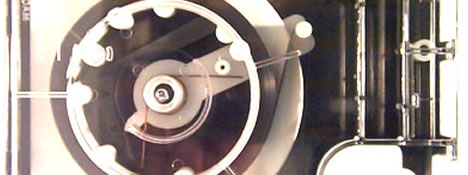
The next audio format we discussed in Propel’s practicum course was the item that most everyone said (with a groan) reminded them of eight-track tapes. As I had never been put into the awkward predicament of using an eight-track tape – let alone ever seeing one up to that day in class – the cringe-factor was somewhat lost on me. What Propel introduced to us that day was the spool of audiotape called the cart, or cartridge, which, to justify the collective ridicule from the class, was sort of the broadcast equivalent of the very same eight-track cartridges that were popular in the retail industry in previous decades. Propel had dug one out of his personal archives for this bit of show and tell, too.

Tape cartridges were, once upon a pre-digital time, what the radio industry used for the playback of material over the air, be it music, commercial spots, or other elements like jingles or liners. Those who were not privy to the true differences might actually confuse them for their somewhat ridiculed eight-track brethren but we would be trained to tell the two apart. Which, we found out quite quickly, was a wholly simple task.

What made the cart memorable was the key fact that was beaten repeatedly into our heads: the tape is endless. If a brand new, never-been-used cart is placed in the playback machine and the “play” button is pushed, the tape would roll through the machine indefinitely with nothing save a power outage able to stop it (I suppose you could unplug the cart machine to make it stop but then that’s messy and cheating...). No, the only thing that could stop the tape was an inaudible 1 KHz cue tone that was added to the tape during the recording process.


Say you had cartridge that held the equivalent of 0:70 seconds and you’re recording a 0:60 second public service announcement. When the user presses the record and play buttons a cue tone is placed on the audiotape to signify the “start” of the tape. Once the 0:60 seconds are completed the user presses the stop button. To return the tape to the “start” the user presses play by itself, allowing the tape to run for approximately another ten seconds before it stops – the inaudible cue tone has told the machine that this is now the stopping point. More importantly, the cartridge is now “cued” such that it will play from the “start” when the play button is pressed.

Here then was one of the ongoing issues we had at the radio station: people stopping carts before they were cued. It was a major inconvenience (and embarrassment) for a DJ to finish talking during a stop set and then hit the play button on the cartridge machine only to have the sound of shuffling audio tape hiss out over the air. Why did students stop the tape if the machine would do it automatically for them? Who can really say. I sometimes chalked it up the “neat freaks,” the students who assumed that once the 0:30 second spot was done playing that they needed to remove the cart as quickly as possible to get it out of their way. Too much clutter bogged these people down. There were other excuses, too. One person stopped them because the machine was too loud and she complained it distracted her. Another countered that all his carts were always stopped so he felt he should return them the way he found them. I recall one student who “bragged” that he only cued his carts at the end of his shift – it made “more sense that way” he claimed, although it didn’t to me. (It still doesn’t.)

I was always just a user of the carts during my undergraduate years, but about my junior year something sparked a sudden interest in rebuilding carts, something I found utterly out of my league. The idea was to find chipped or broken plastic cartridges and carts with bad audiotape and then combine the best of both: quality audiotape was put into well-kept cartridges and bad audiotape and irreplaceable cartridges were discarded. It may have not been time consuming but there were a lot of tiny parts – wheels, levers, pieces of plastic, and so on – that deterred me from learning the reassembly process.

Usage of carts never diminished: we were using them when I started working at the station and we received a shipment of new ones shortly before I graduated. Carts weren’t a new concept – they seemed the antithesis of anything digital – but we gave them the love they deserved.

...an endless loop of love....

- - - - - - - - - - - -
Tape Loop
(Skye Edwards/Paul Godfrey/Ross Godfrey)
Morcheeba
From the album Who Can You Trust?
1996

Tape loop, keeps on turning round, forever,
Patience, love is coming 'round for your pleasure,
Wait now, no use trying to push, there's no need,
People, go against the grain, with their greed.

I've been here before, it ain't gonna work no more,
I've been here before, it ain't gonna work no more.

Focus, your mind will be strong, no distractions,
Soak up wisdom all year long, and then take action.

I've been here before, it ain't gonna work no more,
I've been here before, it ain't gonna work no more.

I've been here before, it ain't gonna work no more,
I've been here before, it ain't gonna work no more.

I've been here before, it ain't gonna work no more,
I've been here before, it ain't gonna work no more.

Sunday, June 29, 2008

Coming closer to the end of your game, and no one seems to care

The characters of Rex Hall that I’ve touched upon already were more or less a normal bunch: Alan and Michael Arthur were pretty easy to get along with and for all of Kenny Jones’ quirks and crotchets he was, at the core, an all right guy. But on rare occasion our dinner-time get-togethers were not with the already established Rex Hall Trio but the Rex Hall Quartet, and that’s when some of the fun got sucked out of the Octumvirate’s table.

On those nights we were blessed with the presence of Mike Smith – who had come out of his hole to eat with us. Mike was the bespectacled roommate of Kenny and (obviously) the other suite mate of Alan and Michael. We had heard rumors of Mike long before we first saw him, when Kenny had casually mentioned this roommate of his with great dexterity and a superb knowledge of video games. Alan and Michael had tales of how Kenny and Mike’s room was void of any light (trash bags covered the windows) and of the number of guests they regularly received for video game competitions. From these stories we sort of had our ideas of what this “Mike” must be like. We were a bit off the mark when we first saw him face to face.

I still remember my first encounter: I was late, lagging behind, and arrived at the cafeteria a minute or two behind everyone else. A handful of students separated them from me and I stood and watched Morty, Alan, Leonard, Phil, Michael, Kenny...next to Kenny was the surliest looking fellow I’d ever seen, staring off into space while the other six chatted aimlessly. In a nutshell, Mike’s facial expressions seemed to say that everything was bothering him, be that his roommate, the dining hall, the people in the dining hall, the people not in the dining hall, and or whatever else crossed his mind. To him, everything that tore him away from his own little world was just an inconvenience. How he was ever talked out of his sub-ground level room of Rex Hall I never knew.

Our first meal with Mike wasn’t that great and the subsequent times he appeared danced around the same level of comfort: yeah, sometimes he was bit more civil but then seemed twice as snide, so for the most part you knew you weren’t going to get anything of any merit out of him. That attitude didn’t go over well with the rest of us and as a result we often didn’t pay much attention to him when he showed up – which is probably why I remember very little about him. But even in the midst of Mike’s standoffish mannerisms, Kenny still tried for weeks to get some of us to come over to play a couple rounds of video games with the two of them before they started in on the competitions the two hosted nearly every night. Those of us invited usually excused ourselves by saying Stan had invited us to a recital and...well, you get the idea.

Still, for all the “fun” Kenny was having with random acquaintances and perfect strangers showing up a couple times a week to play video games well past midnight, you got the impression he tired of that environment quickly and liked having these “social” outings with other people. They were awkward interactions, at best, but it was painfully obvious Mike did not share the same level of enthusiasm as Kenny. It should come as little surprise that Mike’s meals with us in the dining hall became less frequent as the first semester wore on and he was nothing more than a distant memory by the end of the school year the next spring.

But we all became distant memories by that point in our lives, with the eight of us moving onward to better and bigger things. Our little “group of ate” had served its purpose by that time and we needed to focus on more important issues – schoolwork, graduation, life, and so on.

In short: game over.

- - - - - - - - - - - -
Game Over
(unknown)
Overcome
From the album Blessed Are the Persecuted
1996

Deep inside your life, there is a void to fill with what you cannot find.
Lonliness finds you, you find there is a need, there is a need to kill.
But who's life is at stake here now, when did your own life become such a threat to you, you lookd around, is there nothing left, nothing left for you to do.
Is this the end of you string?
You find a welcome mat of death's sting.
Sorrow. Pain.
Coming closer to the end of your game, and no one seems to care.
Need something new, a breath of fresh air.
Done it all, nothing left to try.
It's time to see your life is a lie.
Lie.
It's time to change your life.
And a new gift has been offered to you.
A gift of peace, a gift of new life.
And new doors have been opened for you.
Jesus is waiting there to see you through.
The one who does give more than anything this world could give.
The one who does give more than any lifestyle you could live.
Anything this world could offer you, anything this world could ever give.

Sunday, June 1, 2008

From magic beans and golden eggs to swollen livers and tired legs

During my freshman year I was rather surprised the number of places I went on campus and found that the university’s radio station was playing. I don’t know – I figured most people would not want to listen to awkward-sounding students muddling through their first attempt at being live on the air. It was nice to know that the station had an audience, but it could set you back when you realized just how many people were potentially listening to your sonic booms (i.e. mistakes). I mean, did everyone in Morra County have to listen right now?

I remember being pleasantly surprised that the main cafeteria on campus played our station, too. Café Belvedere was in the basement of the WPA-era Belvedere-Agora Hall, a female-only brick-and-mortar dormitory. Campus historians liked to tell the story that the dorm was built on the site of an old frame building that served as the first campus eatery and that Elizabeth Cady Stanton once spoke there on the matter of women’s suffrage. At this point in their story the campus historians liked to laugh at what they called irony, although if that were a joke it flew over the heads of most audiences. Anyway, once the new dorm was complete the basement became a huge dining hall with meals served to the girls at regularly scheduled times. As the lives of students changed over the decades this practice fell by the wayside and back in the 60s or thereabouts it became the largest of the three campus cafeterias.

Those odd members who made up the Octumvirate usually assembled at the western edge of the building at the opening of a long, subterranean walkway. At the opposite end was the main entrance and where a plump little woman named Katy sat. Her job was to scan the ID cards and permit entrance to the cafeteria which she did perched atop a lofty barstool. A short woman, probably no taller than five feet, Katy was a little scatterbrained and did her best to memorize the names of the students who passed through Café Belvedere. For some reason – one I never sought to correct – my ID card had only my initials and thusly I received a hearty, “Hello, M.C.” every time I entered.

Most of the employees behind the counters were students, though I never saw anyone from my classes; just as gratifying was that I never saw any of the employees walking around on campus. It was from behind the counters and in the kitchen area that I sometimes heard the radio station playing. Weekdays it was often too loud to hear anything, much less the employee in front of you but you could often make out the rambunctious radio noise on the weekends.

The only employees worth remembering were Staci Guard, the overly friendly sandwich counter girl, and Piggy, the rather round fellow that must have drawn the shortest straw daily to always get pizza detail. Staci always tried to “ham” it up with pastrami or tell “cheesy” jokes about the size of pickles, which meant she always had an audience. Piggy was less riveting than Staci and his endless boredom was regularly a ripe target for jabs. Of course, his real name wasn’t Piggy, but Mike Arthur and I named him for the William Golding character based on looks and general disposition.

Morty dubbed the fat, bearded man who wandered around the cafeteria as “Lucky Charms” because he sort of looked like a cereal mascot. We all about lost our lunch during the spring semester when he stepped out of his office dressed up in gaudy green garb for St. Patrick’s Day. Acting like a busybody, Lucky Charms darted behind counters or out among the students eating with neither place suiting him very well. Employees appeared to dread it when he stood over their shoulder (Staci wasn’t as chipper as she normally was), and those of us eating didn’t care to be interrupted with impromptu surveys of cafeteria likes and dislikes. Lucky Charms was later replaced by ABE, the Angry Black Employer.

A couple of years later the radio station had an unsuccessful live remote in the Belvedere-Agora cafeteria. Thankfully I wasn’t there as either a station staff member or as a member of the Octumvirate. By that time the Octumvirate was all but dead anyway.

- - - - - - - - - - - -
Suppertime
(The Odds)
The Odds
From the album Nest
1996

an embarrassment of riches
up ahead between the ditches
steady on
pails of blue grass beads and baubles
in the toilets of the supermodels
steady on
watch what you wish for
as someone else pollutes it
some see the rarest bird
and hunt it down and shoot it
let me lose so beautifully
let me lick the dew from the money tree
have the moms of world all care about me
at suppertime
the road to wreckage stretches west
from survival to excess
and beyond
from magic beans and golden eggs
to swollen livers and tired legs
trammel on
the breakfast of failures
is an unexacting list
subtract oppurtunity
you can mix it up with your fists
let me lose so beautifully
let me lick the dew from the money tree
have the moms of world all care about me
at suppertime
let me feel what it's like to have it
let me battle all of your rich man's habits
let me cry down the front of a smoking jacket
after suppertime
let me stand hypnotized by what I'm doing
smell the orchids by the road to ruin
when the heirs are asleep and we think about screwing
after suppertime

Sunday, March 30, 2008

Things are moving way too fast, pull me up before I pass

Most, but not all, of the undergraduate three-hour courses had an associated practicum course, commonly referred to as "lab,” where we got our hands-on training. These mandatory lab courses met only one hour a week and were made up of students from the various sections of the mother course. The "mother course" meant, for this first semester, my Introduction to Broadcasting course that met Tuesday and Thursday mornings. There was another section of the course that met the afternoons of those same days, and students from both sections could sign up for any one of the half dozen-or-so lab times on Mondays and Wednesdays. That in turn meant your lab might consist of people not in your regular Intro course.

I found some of lab sections somewhat boring, considering I was already familiar with some equipment from my work at the radio station. Mind you, I was by no means an expert but I was a fast learner and I didn't enjoy having to go through how to record my voice from the microphone via the audio board. Not everyone was participating at the station, so I'm sure it was interesting for those people. Plus I was now going to be graded in my ability to record my voice, so I should, at the very least, pretend to do with some skill. I also found I had no issue speaking to the entire county over the airwaves, but yet got nervous when I had to do something in front of the class-size audience.

The labs did help to illustrate what Dr. Propel was yammering about during class because being told how equipment worked or was used in “the real world” went only so far. I mean, really: reading about how to cue a record on a turntable is different from actually doing it yourself and hearing the "wow" noise when you do it improperly. Like, wow, man.

During my first two years in program the labs were graded like others classes: students received a letter grade for their efforts. Midway through my time as a student the faculty decided (that is, I assume it was them that decided) to change this to "pass/fail." By that time I was done with all the mandatory labs, but ultimately I should have been unconcerned because I knew if I were in such a class that I would put forth the effort to receive the "pass" grade at semester end.

There was a group of us, though, that were less than thrilled about the change. It was a small group, mostly comprised of student management at the radio or television stations, that all had the shared experience of going through the Advanced Audio course with Dr. LeMeck. LeMeck expected you to work in his course – there were no such thing as an "Easy A," much less an "Easy B" – and he set the bar a little higher than some of us originally envisioned it. Part of our displeasure in the change in grading is that we had been required to put forth great efforts to just get a passing grade; now students could do "A-level work" or "C-level work" and still "pass" the course. We felt that the new crop of students coming up would not be as battletested as we were or put forth the amount of effort we did to keep things going strong.

Propel's labs were more or less the same as his classes: direct, informative, and the occasional goofy comment on something. It was going to be an interesting semester as far as I could see.

- - - - - - - - - - - -
Sea
(Joe Sib/C. Shifiett)
22 Jacks
From the album Uncle Bob
1996

think I might go down today
complications way to deep
wanna swim way out to sea
implications on my skin
feel the situation rise
told myself to many lies
working for the good of all
and now I’m gonna take their fall

if I go under
why even come back

think I might sleep today
things are moving way too fast
pull me up before I pass
got anchors on my ankles
then again I better go
cause everybody here will know
think I might drown today

just motionless and stuck in it
just motionless and heartless
somebody give me a push
before I drown
don’t wanna go down

Sunday, February 17, 2008

There's no one home, no messages on the telephone

There were two telephone machines in the main studio of the radio station. One sat to the left of the audio board and was the main line of communication in and out of the station – requests came in, calls went out seeking a current temperature (and wind speed, if so desired...). On the right side of the audio board, pushed back behind everything else in the world, was the other phone, a dingy, dusty thing that saw little daily use.

It was, in effect, the back-up phone. Say, for example, we're on the road broadcasting university basketball games. We can't take the portable transmitter unit over great distances, so for some out of town (practically out of state) games the play-by-play team would broadcast via a phone drop. Using the second phone meant the main phone lines could be kept open for their intended use, like requesting music by groups such as the Hunger. This Houston, Texas based group’s best known song was probably Vanishing Cream, a song I always thought somehow fused reggae with metal. It got some decent spins on our station, as well as countless others, during the mid-1990s.

Anyway, that’s where the story of the secondary phone should end - the story of an underused appliance and the people who scantily used it. But it doesn't. The main phone line was connected to a small light box sitting atop of the audio board. We knew we had an incoming call when the light flashed, thus preventing any awkward ringing noises from going out over the air. The secondary phone line didn't have a light box and therefore did make noise – regardless of whether or not the microphone was open or not.

Dubbed the "magic phone," the number was shared amongst student management and faculty as a way to get the attention of the DJ on duty. I think the original concept was that if a shift was going badly, someone could call the secondary phone for prompt service. Actually hearing a phone ring would grab the DJ's attention, who would answer it and either be read the riot act or asked what just what the heck was going on in there. You knew if you got a call on that phone that it just was more than just a regular listener.

But somewhere along the way the concept blew a bit out of proportion. I don't remember what combination it was of on-air DJ and dissatisfied student director, but the student yammering away on the air was suddenly taken back by the sound of a phone ringing in the background. You could hear it plainly on the air and it was actually a bit funny, the DJ fumbling for both an excuse to its sudden sound as well as a way to pick it up without walking away from the microphone (it always sat just out of arm's reach).

Heh-heh...well, now, this was a way to test those pompous jocks who thought they were the bee's knees at the station. What better way to deflate their ego than having a phone suddenly ringing? And what would be the best way to infuriate them just a bit more? Hanging up the phone as they ended their break, of course. Unfortunately the "magic phone" trick got to be too popular and soon DJs were starting their three-hour shifts by unplugging the phone. While it was a nice way to get back at the people calling, it didn't help that the DJs were forgetting to plug the phone back in.

Oh, well.

For those expecting a call about the Hunger, don’t count on it. They’re still going at it with their most recent album being 2005’s Finding Who We Are.

- - - - - - - - - - - -
Vanishing Cream
( The Hunger)
The Hunger
From the album Devil Thumbs a Ride
1996

Who fills the sky
Who answers when I cry
I feel alone, I feel abused
I feel there's nothing I can do
It's getting late
There's no one home
No messages on the telephone
I feel so good today
It's hard to stay away
A hunter and his prey
Today will be the day
Is this real, is it you
Are you what I see
Is it him, am I good
Or just vanishing cream
Is there truth, how many lies
Am I a fool to believe
Who's in my bed
I feel misled
It's just vanishing cream

Sunday, February 10, 2008

Someone who knows how to ride without even falling off

I never really put much thought into how a body reacts to a DJ shift. Granted, when I started out in radio, I wasn't too interested in that aspect so naturally I paid it no mind. But as I branched out – and finally took the plunge, as it were – I realized that it took some stamina.

In my undergraduate days, all music shifts (save the Saturday morning four-hour folk show) were three hours shifts; when I went off to graduate school, that station's shifts were just two hours. I still think three hours is the best way to go. This way the student has the chance to warm up to the craft: if the first hour is a little stale, he or she still has two hours to pull off something listenable. If the shift is two hours then by the time things start falling into place, the DJ is getting ready to leave. I remember making the comment in graduate school that two hours seemed short. I wasn't expecting, however, most of those students to counter with three hours sounding too long.

Well, to be honest with them, it could be long, but I think it mattered which music format you were stuck with. Shifts that allowed the DJ to interact – such as rock, jazz, folk, or hip-hop – tended to move faster because of shorter songs, more breaks in programming, and the feeling everything is clipping along at a quick pace. A classical shift might end up with two different but similar sounding dirge-like pieces making up the entire three hours – and if classical wasn’t your bag then you were stuck like Chuck.

There was another definition of "being stuck" that was worse, though. That was being stuck at the station because the DJ that was supposed to come in after you didn't show up. That was one of the worst feelings to have, watching the clock dip into that fourth hour. Did the guy who was supposed to relieve you just vanish off the face of the earth? Usually not, but there was a good chance you would have to at least start the next three hours of music, in hopes he or she was just running late. Often that wasn't a problem but it could be if you had to jump formats...say, from three hours of classic rock to the first of three hours of R&B.

I can speak from experience on that. My regular classic rock shift was noon to 3 pm, but I had made a deal that week to cover for the DJ who went on 3-6 pm. After six hours in the booth I was ready to go...and then 5:45 rolls by and no one’s there to replace me. Now, when this happened to other people it was always fun to hear the exasperated or exhausted voices mouth off about picking up the slack for so-and-so or that whosis was tardy. Moving to the R&B playlist, I kicked off the next hour in hopes someone would show up. Telephone calls were of little help, as no one answered the phone. With a sigh that almost sounded like a yawn, I opened the microphone at my first break and welcomed the listeners with, “Greetings and Hallucinations, everyone....” Based on that alone, the faculty advisor called and said to hold tight, he’d come pinch hit for a bit and let me get out of there.

One of the first songs I played that night was Ginuwine’s Pony (and if you know anything about the song, the next thing you don’t want to hear is “Greetings and Hallucinations”). With a weary and wandering mind, and somewhat annoyed to be put in this position, I made a mental note that cemented that song, my situation, and my disdain for the delayed DJ in my head: that DJ, whoever he was and wherever he had disappeared to, was a genuine horse’s ass.

No offense to Mr. Lumpkin, of course. His Back II Da Basics was released in 2005, followed by a greatest hits album the following year. A new album is reportedly in the works.

- - - - - - - - - - - -
Pony
(S. Garrett/Elgin Lumpkin/Tim Mosley)
Ginuwine
From the album Ginuwine... The Bachelor
1996

Im just a bachelor
Im looking for a partner
Someone who knows how to ride
Without even falling off
Gotta be compatible takes me to my limits
Girl when I break you off
I promise that you wont want to get off

If youre horny lets do it
Ride it my pony
My saddles waiting
Come and jump on it

If youre horny lets do it
Ride it my pony
My saddles waiting
Come and jump on it

Sitting here flossing
Peepin your steelo
Just once if I have the chance
The things I will do to you
You and your body
Every single portion
Send chills up and down your spine
Juices flowing down your thigh

If youre horny lets do it
Ride it my pony
My saddles waiting
Come and jump on it

If youre horny lets do it
Ride it my pony
My saddles waiting
Come and jump on it

If were gonna get nasty baby
First well show and tell
Till I reach your pony tail, oh
Lurk all over and through you baby
Until we reach the stream
Youll be on my jockey team, oh


If youre horny lets do it
Ride it my pony
My saddles waiting

Come and jump on it
If youre horny lets do it
Ride it my pony
My saddles waiting
Come and jump on it


If youre horny lets do it
Ride it my pony
My saddles waiting
Come and jump on it

If youre horny lets do it
Ride it my pony
My saddles waiting
Come and jump on it


If youre horny lets do it
Ride it my pony
My saddles waiting
Come and jump on it

Sunday, January 6, 2008

Broken hearts and broken bones, this is where we used to live

Bowman-Oates Hall, a dorm that sat a mile or so north of the downtown area, was completed in 1968 but originally began under much duress in the early throes of the twentieth century. That said, it was an interesting place to live, to watch people and the world go by, and to be amazed at how various interpretations of architecture and housing requirements, from just as many numerous university administrators over the years, could seamlessly fit together into what generally could be a very depressing place to live.

The dormitory was originally a wooden frame building built with money and labor from men students on the site of the former Bucket Boarding House. This non-descript boarding house was burnt to the ground after a bonfire, started by many of the same students to - ironically - celebrate homecoming, got terribly out of hand. While conceived as a temporary replacement, the new building remained standing longer than expected and eventually earned "eyesore status" after a mere eight years.

It wasn't until 1912 that famed architect and visiting professor Magnus "Dass" Paulsson (who had famously referred to the building as the "Bucket of Drit House" during a graduation ceremony) designed plans to replace it with a more permanent brick structure. Financial shortcomings prevailed, however, and the university was only able to encase the one-story wooden building within a wall of brick and mortar. The 1911 senior class donated money for a bulbous cupola, installed by 1916.

The fledging alumni association sought to increase awareness of what was now being called the "Men's Dorm" by beginning a Buy-a-Brick program in the early 1920's. For every donation to the program, former students could have a message engraved on the bricks being used to strengthen the foundation (university archives have two such bricks that were part of the program on display). So great was the interest that the university was able to add a second floor – once the cupola was removed.

Little work was done of the dormitory in the years leading up to the Great Depression, as the administration wrestled internally with what to do with the cupola – replace it atop the two-story building or delay installation. Now bearing classical Greek overtones, the building sported five columns that represented the university's then-five schools (now colleges), and some of the eeriest graffiti this side of the Mississippi.

Once the decision to replace the cupola was made, President Bowman resigned and returned to active duty with the United States Air Force. Following his death overseas, the university renamed the residence Bowman Hall, with plans to double the occupancy. Due to a misunderstanding with the building contractor, the third and fourth floors were constructed adjacent to the first and second floors. The pedestrian walkway between the two halves was covered in the mid-1950s, shortly before the "second half" won the honorary name Oates Hall in a raffle.

By 1961, the need for more housing prompted the university to try again with the additional floor space. There was just cause for celebration when the building blossomed into a four-story dormitory, though restricted entirely to female students. Modifications during this time included, externally, the addition of a gaudy amount of aluminum trim and the bricking up of dormer windows, as well as the realization that most of the area on the third floor of Bowman Hall was taken up by the cupola. It was eventually wedged out a window as a protest to the war in Viet Nam, student service fees, and other what not. Bowman-Oates Hall went coed by the 70s, prompting streaking and Oates Hall to sprout a wing of rooms on a truncated fifth floor, dubbed the Pentahouse. (No reason was given as to why Bowman Hall remained four stories.)

Anyway, by my time on campus, the university had grown up and out around the old residence – one of the two streets it sat adjacent to was redeveloped into a mall area that straddled the line between progressive academic buildings (like the neighboring Communication Building) and chintzy, kitschy post-WWII era schlock (the over-remodeled residential areas between downtown and campus). Across the other street (now a delivery zone terminus) was the rear of the Communication Building and the skeletal radio tower. This tower stood out like a sore thumb for a few reasons, the main one being its height (approximately 200-feet tall). There was a certain architectural charm to it, too, as it was a modern convenience on a horizon surrounded by mostly 80-to-90-year-old buildings.

Not long into my freshman year I heard the urban legend about certain rooms of Bowman-Oates Hall being able to pick up the radio station. That's right - due to the proximity of the tower, people said they were actually able to hear the radio station in the aluminum siding, window frames, and air conditioner units in rooms facing the Communication Building. I never knew how clearly these people could hear the station – apparently noticeable enough to perceive sound – or if there were atmospheric conditions that allowed this, but it was one of those odd stories that popped into my mind from time to time. I wondered then where else could you hear the station? The tiny metal cylinder on the end of pencils? The braces on your teeth? The metal chairs in the lobby? In my later years during a music shift, I related the story and dedicated an hour’s worth of music to those listening across the street; I’m sure it must have sounded strange and I wondered if the audience envisioned students with their ears to the wall.

There was little celebration of the old apartment building’s 100th year – or at least the centennial of when the original section of the building was constructed. I don’t think much noise was made when the building was finally leveled a number of years after I graduated, either.

- - - - - - - - - - - -
The Old Apartment
(Steven Page/Ed Robertson)
Barenaked Ladies
From the album Born on a Pirate Ship
1996

Broke into the old apartment
This is where we used to live
Broken glass, broke and hungry
Broken hearts and broken bones
This is where we used to live

Why did you paint the walls?
Why did you clean the floor?
Why did you plaster over the hole I punched in the door?
This is where we used to live

Why did you keep the mousetrap?
Why did you keep the dishrack?
These things used to be mine
I guess they still are, I want them back

Broke into the old apartment
Forty-two stairs from the street
Crooked landing, crooked landlord
Narrow laneway filled with crooks.
This is where we used to live.

Why did they pave the lawn?
Why did they change the locks?
Why did I have to break it, I only came here to talk
This is where we used to live

How is the neighbor downstairs?
How is her temper this year?
I turned up your tv and stomped on the floor just for fun
I know we dont live here anymore
We bought an old house on the danforth
She loves me and her body keeps me warm
Im happy here
But this is where we used to live

Broke into the old apartment
Tore the phone out of the wall
Only memories, fading memories
Blending into dull tableaux

I want them back
I want them back

Sunday, October 28, 2007

I'm not scared, I'm outta here

A few reminders about this song, especially this time of year...never have I seen, more so heard, so many people misunderstand the concept of a "false ending."

The phrase is self-explanatory (or so I thought). You’re a DJ and the song you’re playing starts to wind down. You’re paying attention and you think you can guess as to when it will end. But – hold on - it’s not really the end, so you have to be ready for the real ending that will follow, either a second later or longer. Electrolite ends with Michael Stipe singing, "I'm not scared, I'm outta here." The music is trailing off and the impending end of the song is close at hand and just when you think he’s done singing whatever it is the song is about, he adds one more "I'm not scared." The music has ended by now and following a brief pause, he adds a final, "I'm outta here."

Perhaps, as student management, we had chastised anything remotely similar to "dead air" upon our fellow undergraduates. Perhaps these DJs wanted to tighten their board and not waste those precious seconds of empty airtime. Whatever the case, no sooner had we entered Electrolite into rotation did we discover that DJs were assuming that once the music was over that the song was over. No, that would be a false assumption – similar in concept to the aforementioned false ending. Yes, once they assumed the song had ended, people were beginning another song, running a station liner or sweeper, or (funniest yet) opening the microphone and talking – just to be interrupted by Stipe's singing a few seconds later.

In an attempt to make things easier on the staff – since these same DJs were not bothering to put the CD into the cue channel and listen to the ending before they played it on the air, which would have solved this problem – the music director added a note to the playlist that this song had a false ending. From there it was always a hoot to hear which people read the playlist verses those who didn't. If we, as station management, "magically" showed up a few minutes later, more often than not the DJ would mutter something about the trick ending of the song throwing them off. After a while you could only smile and nod – and then point out the note on the playlist. That is, if you wanted to spend that time beating it back into their head.

I personally knew about the ending because I owned a copy of the album and had listened to the song numerous times, becoming familiar with the nursery rhyme-like simplicity of its wistful lyrics. You wanted to sing-along with phrases like Steve McQueen and James Dean – know what I mean? It spoke of a loss and of how things could have been and sounded anything-but-upbeat and thus was the perfect song for me to sign-off with when ending a melancholy Halloween evening a decade ago –

Descanse en la paz.

- - - - - - - - - - - -
Electrolite
(Bill Berry/Peter Buck/Mike Mills/Michael Stipe)
R.E.M.
From the album New Adventures in High-Fi
1996

Your eyes are burning holes through me
I'm gasoline
I'm burnin' clean

Twentieth century go and sleep
You're Pleistocene
That is obscene
That is obscene

(chorus)
You are the star tonight
Your sun electric, outta sight
Your light eclipsed the moon tonight
Electrolite
You're outta sight

If I ever want to fly
Mulholland Drive
I am alive

Hollywood is under me
I'm Martin Sheen
I'm Steve McQueen
I'm Jimmy Dean

(repeat chorus)

If you ever want to fly
Mulholland Drive
Up in the sky
Stand on a cliff and look down there
Don't be scared, you are alive
You are alive

(repeat chorus)

Twentieth century go and sleep
Really deep
We won't blink

Your eyes are burning holes through me
I'm not scared
I'm outta here
I'm not scared
I'm outta here

Sunday, August 12, 2007

Come check my sockets for eyes

At my undergraduate station we did not, surprisingly, have a lot of full-length albums for the rock shifts. Don’t laugh - we weren’t as clueless at that makes us sound. We had some full albums, usually due in part to a record label sending some promotional copies our way, or someone on staff donating their copy to the station for either a short-term or permanent loan. A majority of the music came in the form of weekly preview discs. Every Tuesday afternoon there was a dash to the mailroom – like kids racing toward a Christmas tree – to see what tracks were included on this week's blue disc. If there was a song on the disc that we didn't have yet, we could quickly enter it into rotation. Or, as it were many times, the song wasn't included and we would have to wait in hopes that the latest track from the "it" artist of the week was included on the next disc the following week.

Ripping open the package, the directors scanned the disc to see what was salvageable. Even though the discs had 10 to 20 tracks, the music ranged from what was considered adult alternative to loud rock. The music director would then decide which songs, if any, we would put into rotation. Sometimes we featured over half the songs on a disc, other times we played only two out of the twenty tracks, thereby wasting a lot of space in the control with a rather useless disc.

Still, we were on the mailing list of some prominent record labels and, from time to time, we did receive some prominent albums. Nothing was more "prominent" the week that we found an album from some English-sounding group called Subcircus. What was special enough with either that band or our station to warrant this album be sent our way out of a whole slew of other possibilities? The music director and I listened to a few of the tracks and decided to add the strongest sounding one into rotation. We really liked the second track, a somewhat catchy tune called 86'd.

Subcircus was indeed from England, a quartet of musicians that included Tommas Arnby, Nikolaj Bloch, Peter Bradley, Jr., and George Brown. The foursome came together in the mid-1990s, making a name for themselves on the club circuit before releasing their debut album, Carousel, in 1996; it hit the United States market the following year. And that’s about all we heard from them. The group became another random band, one nobody had heard of prior and I don't think anybody has heard much from them since. Well, I see they released their follow-up in 2000 but I don’t think it was enough noise to grab anyone’s attention this side of the pond.

While I liked the track and it got moderate airplay on the station, it never blossomed into the hit that I think the band or label hoped. However I did get a chuckle many months later when our Tuesday preview disk arrived and I noticed that 86’d was included on the disc. Wow – were we really that far ahead of the game for once? While I now see this might be due to album being released at different times in England and the United States, at the time, the music director and I found it a triumph for the station. We had gotten the full album what seemed like a year before the preview disc people thought the song was popular enough to include.

We were happy, we were boasting, but I just don’t think anyone cared at that point.

- - - - - - - - - - - -
86’d
(Subcircus)
Subcircus
From the album Carousel
1996

Sunday, April 8, 2007

I wanna *poink* you like an animal

Alfred Yankovic has been making, and remaking, music for three decades and I really don't think the guy's gotten stale – although I must admit some of what he's recently been poking fun at is a bit out of my vocabulary (meaning I don't know anything about Avril Lavigne or Disturbed yet I still hum Men Without Hats' songs).

This album, like most of his recorded output, is a sort of a pop culture state of the union, an aural time capsule of good, bad, and ugly trends and tastes (again with the Men Without Hats). Bad Hair Day album covered the mid-90s and most of the songs, or style of songs featured, were those we at the undergraduate station were very knowing of after playing them time and time again: Soul Asylum, TLC, Foo Fighters, Coolio, and more. After giving it a few spins at home, I brought the disc in to the station so others could appreciate a satirist's taste of the stuff we were spewing and, as expected, everyone loved it – to the point that disc lived at the station for a while.

I was a tad surprised to learn that one of the DJs did in fact pull it out of the music library and into the control room the following month for an attempt at an April's Fool joke. Yankovic's music fits in the "rock" genre, which the undergraduate station inundated the airwaves with from three o'clock until midnight. Obviously by the time 11:50 PM rolls around, the last DJ of the day is winding down the music and getting ready to shut things down for the day. The April's Fool joke of this DJ, then, was to play upon the observation that after the last stopset of the day, roughly 11:50, there would be about ten minutes of music played before the station signed the transmitter off. There was no readily way for him to fit in "requested" Nine Inch Nails, some Beck, R.E.M., Sheryl Crow's All I Want To Do, plus more, in that short a time span.

Of course, there was time.

Thanks to Weird Al and his melody of alternative rock staples titled, appropriately enough, The Alternative Polka, we were able to get all those excellent artists and more more compressed into five minutes of either sing-along silliness or nerve-racking annoyances that was probably the last thing our listening audience expected us to ever air.

Boy, college-run stations could be fun.

- - - - - - - - - - - -

Alternative Polka
(Beck/Karl Stephenson; Dean DeLeo/Eric Kretz/Scott Weiland; David Baerwald/Bill Bottrell/Wyn Cooper/Sheryl Crow/Kevin Gilbert; Trent Reznor; Bill Berry/Peter Buck/Mike Mills/Michael Stipe; Glen Ballard/Alanis Morissette; Billy Corgan; Flea/Anthony Kiedis/Dave Navarro/Chad Smith; Dave Grohl; Chris Cornell; Billie Joe Armstrong/Green Day; Yankovic)
"Weird Al"Yankovic
From the album Bad Hair Day
1996

["Loser" by Beck]
Soy un perdidor
I'm a loser, baby,
So why don't you kill me?
Soy un perdidor
I'm a loser, baby,
So why don't you kill me?
Hey!

["Sex Type Thing" by Stone Temple Pilots]
I am I am I am
I said I wanna get next to you.
I said I'm gonna get close to you.
You wouldn't want me have to hurt you, too.
Hurt you, too.
I know you want what's on my mind.
I know you like what's on my mind.
I know it eats you up inside.
I know you know, you know, you know.
Here I come I come I come I come.
Here I come I come I come.

["All I Want To Do" by Sheryl Crow]
All I wanna do is have some fun.
I gotta feeling I'm not the only one.
All I wanna do is have some fun.
I gotta feeling I'm not the only one.
All I wanna do is have some fun.
Until the sun comes up over Santa Monica Boulevard.

["Closer" by NIN]
Help me--I broke apart my insides.
Help me--I've got no soul to sell.
Help me--The only thing that works for me.
Help me get away from myself.
I wanna *poink* you like an animal.
I wanna feel you from the inside.
I wanna *boing* you like an animal.
My whole existence is flawed.
You get me closer to God.

Hey! Hey! Hey!

["Bang and Blame" by REM]
You bang bang bang bang bang.
Blame blame blame.
You bang bang bang bang bang.
It's not my thing so let it go.

["You Oughta Know" by Alanis Morisette]
'Cause the love that you gave every day wasn't able
to make it enough for you to be open wide
No!
And every time you speak her name
Does she know how you told me
You'd hold me until you died?
'Til you died.
Well you're still alive!
And I'm here to remind you
Of the mess you left when you went away.
It's not fair to deny me
Of the cross I bear that you gave to me.
You-ou-ou-ou-ou oughta know!

Hey!

["Bullet with Butterfly Wings" by Smashing Pumpkins]
Despite all my rage,
I am still just a rat in a cage!
Despite all my rage,
I am still just a rat in a cage!
And someone will say
What is lost can never be saved.
Despite all my rage,
I am still just a rat in a cage!

["My Friends" by Red Hot Chili Peppers]
I love all of you
Hurt by the cold.
So hard and lonely, too
When you don't know yourself.

["I'll Stick Around" by Foo Fighters]
I don't owe you anything!

["Black Hole Sun" by Soundgarden]
Black Hole Sun
Won't you come
And wash away the rain?
Black Hole Sun
Won't you come, won't you come
Black Hole Sun, Black Hole Sun
Won't you come
Black Hole Sun, Black Hole Sun
Won't you come
Black Hole Sun, Black Hole Sun

["Basket Case" by Green Day]
Do you have the time
To listen to me whine
About nothing and everything all at once?
I am one those melodramatic fools.
Neurotic to the bone,
No doubt about it.
Sometimes I give myself the creeps!
Sometimes my mind plays tricks on me!
It all keeps adding up.
I think I'm cracking up.
And am I just paranoid
Or am I just stoned?
Or am I just stoned-oh-oh-oh-oh-ned?

Hey!

["Ear Booker Polka" by Al Yankovic]

Sunday, February 25, 2007

I'd be inclined to slap you in the mouth

This was a favorite song of the Program Director who had a short-lived tenure before me. I know the station surely never received any sort of promotional copy of the single, much less album, leaving me to assume Diane, the briefly-serving program director, brought in her own copy.

The practice of bringing in outside music was generally frowned upon by the faculty advisor and thus usually championed by the leading student managers. Our issue was that people who brought in outside music usually played only their music – and the prepared playlist went by the wayside. Management's concerns was that it wasn't fair to other DJs that they didn't have the option to play those songs; also, since these outside songs had not been cleared by the music director, the music might not have fit the format or that prerequisite "sound of the station" ideology, or there could be a potential issue with lyrical content. Already short a number of then-popular songs, to suddenly have something popular in rotation, like Merril Bainbridge, meant you wanted to have the option to play it at any time, not just when Someone Special was spinning discs for three hours. In short, management said if you wanted to play your music you had to donate your music. Few people were that generous; those that did usually passed along a compilation or greatest hits disc, only to remove it from rotation at the end of the semester. Hence why we had the Doobie Brothers for only one semester of classic rock.

Anyway, I really never had anything against Merril Bainbridge, but her mouth – and the words she sang from it - seemed to garner airplay only on Diane's shifts and, more so, during those first three hours of the rock format (again, the historically lightweight pop hours). I guess it wouldn’t have given me such a problem but Merril Bainbridge seemed to come out of nowhere and then as quickly as she opened her mouth, she was gone. Poof. Just like Kiser Sosa. If anything, I'm always reminded of Diane when I hear this song – which isn’t that often anymore.

For those keeping score at home, Bainbridge's The Garden featured another popular single, "Under the Water," in her native Australia. Her second, and to date, last album, was Between the Days in 1998; she has since spent her time writing and composing music for other musicians in her native country.

- - - - - - - - - - - -

Mouth
(Bainbridge)
Merril Bainbridge
From the album The Garden
1996

I feel like I've been blown apart
There are pieces here
I don't know where they go

Kiss me on my salty lips
I bet you feel a little crazy
But for me
We'll be famous on TV

Chorus
Would it be my fault if I could turn you on?
Would I be so bad if I could turn you on?
When I kiss your mouth, I wanna taste it
Turn you upside down, don't wanna waste it

I jump on you, you jump on me
You push me out and
Even though you know I love you
I'd be inclined to slap you in the mouth

When I kiss your salty lips
You will feel a little crazy
But for me
I'll be famous on TV

Chorus x2

Now, will it be my fault if I
Take your love and throw it wide
You might restrain me
But could you really blame me

And you will feel you're blown apart
All the pieces there
Will fit to make you whole
And I know where they go

Chorus

When I kiss your mouth, I wanna taste it
Turn you upside down, don't wanna waste it
x2

Sunday, December 17, 2006

I don't even think your mirror understands your reflection but that's all right

Okay, so there was this chunky guy who called himself "Seedy" Jones who was a student at the undergraduate station with me. I dunno if the air name was self-applied or any back story – he was maybe five or more years older than most of the other kids hanging around, you know – the "normal" college-aged kids – and was sort of an opinionated smart ass. Yeah, he'd done his share of video production somewhere – maybe another college and he transferred in or something – and could talk his way around steadicams, SVHS, and non-linear editing, among other topics. I think it was the 1996-97 school year and "Seedy" was pulling one of the morning jazz shifts – music he had a feel for and could, you know, dig his fingernails into. Jazz was cool – I didn't know much more than some of the more familiar contemporary songs we played – and I appreciated the fact he'd come across as more than a casual listener and tried to add a little freshness to the mix. "Seedy" was one of the jack-of-all-formats we had, able to sit in on almost any format and pass himself off as someone who knew what he was talkin' about – you know the type, really was on point. Always good to have a few like that around – knew his way around a rock shift and could get you through three hours of classical if needed.

He didn't hold any of the student positions but "Seedy" checked into the Music Library often, hanging out with whoever was there to talk shop, grab some lunch and waste a bit of time in between classes. Talk...the guy wouldn't shut up sometimes, talking about this and that and all points in between; he'd try and be funny a lot and you had to be in the right mood to appreciate the humor. If not, chances are...well, he'd piss you off. Not the "talk down to you" type to your face, more the type who liked to belittle others piece by piece – would quote from The Deeper Meaning of Liff and give nicknames to station staff from words found in the book. Sort of tell you off but leave you smiling cause you didn’t know what skegness, baughurst, or pantperthog meant.

So I never knew or caught on with his Steve Vai shtick – you know, the guitarist – he was the "big thing" for a few weeks. It was supposed to be funny, sort of like that Weekend Update skit on Saturday Night Live about Frank Stallone: "Belgian doctors have accidentally cloned a human being. The human being? You guessed it – Frank Stallone." It'd run like this: a few guys, hanging out in the office listening to one of the weekly preview discs and "Seedy" would barge in. "Hey, I heard they came out with the best and worst album's of the year; he ["he" being whoever we were listening to] made the worst list; the best this year is...Steve Vai." Such was his way of mocking music, I suppose. Of course not everything was as funny as he thought it was. Sometimes he'd just walk in an' ask, "'Zat Steve Vai?" Hardly! – it'd be some pop tune or somethin' by Sheryl Crow or whoever – and we'd just sort of laugh at it. You had to be there. Or "we're goin' off to see that new Clancy movie – you in? "I dunno – hey, Vai do the soundtrack?" Not much of a punch line – Steve Vai! – but I guess it meant somethin' to him. I never could figure exactly what: I don’t think Vai appeared on any of the preview discs and even if he did, we never played it. Not our thing. Might have fit sonically but it wasn't one of the "names" some of the directors liked to play.

Looking back, I see guitar virtuoso Vai did release an album around this time – Fire Garden – but whether "Seedy" knew about it or not is beyond me. One thing's for sure: "Seedy" knew about Vai and his music. That was fine – but I still don't get the joke.

- - - - - - - - - - - -

Little Alligator
(Steve Vai)
Steve Vai
From the album Fire Garden
1996

I could read your mind and all its freakish desires
A full on femme fatale with an elegant face of fire
Through the haze of your senses and your defenses
God only knows how long it is till you hit the bottom
but that's all right
I'll get you through paradise

Don't need your wings
For the Queen
Little alligator

From the fangs the poison is so sweetly injected
The words that fall from your tongue are so filthy
your mouth must be infected
Not a man but not quite a lady
Hopelessly androgenous
Hell only knows how hot it gets down south of the border
but that's all right
Your secret is safe tonight

There is no shame
Glory and fame
For little alligators

In the jungle it's comin' down
For those who live in the lost and found
Can't mistake your attitude so heavy
Now get over here

You can hang your image in a brand new dimention
Cause I don't even think your mirror understands your reflection
But that's all right as long as you're not uptight
And in your brain
It’s all the same

Little alligator

Sunday, December 10, 2006

Since I don't believe a word u say, save it for another

I'm pretty sure Honky's Ladder was the only Afghan Whigs song ever featured on our undergraduate station. In fact, the only reason I know we even bothered with the song was because the program director at the time – a fussy guy named Frankie, who would 1) be replaced by the end of the fall semester by Syd ("the Kid"); and 2) would be seen a year or so later driving UPS trucks – verbally told DJs not to ask over and over again "who Honky was" or "what was up with his ladder."

Evidently over the summer, these less-than-brilliant questions and other similar comments had been used so much that it wasn't funny anymore. If there were people commenting about Honky and his Amazing Technicolor Ladder, I would not be surprised. As much talent as the station had, there were always a handful of people who couldn't think of anything to say about a particular song or artist and therefore come up with some seemingly funny one-liner (also see And I'm dying at 90). If it worked okay the first time, they would usually reuse it each shift the song appeared. And if an influential and popular DJ said it first, other people would try it out on their shifts. Sometimes the joke worked with the person who thought it up – their style of delivery or attitude could pass it off as amusing – but it usually didn't work when DJs blandly recited with little understanding.

From the way Frankie talked about it in the occasional staff meetings, someone who wasn't there over the summer could get the impression that the song might have gotten a bit overplayed, too. Between over-saturation and sub-par efforts at show prep (see Boy, you can't play me that way) this might have been why the song was eventually taken out of rotation. I wonder now if the song was going to be added back into rotation as some point and Frankie either forgot or was fired first and the track became ancient history. While you would think – or hope – something else by the Wigs could have been entered to take its place, I distinctly recall Honky's Ladder being on a weekly preview disc and therefore probably the only track by the Wigs.

For the record, the Wigs broke up in 2001 after one other album in 1998.

- - - - - - - - - - - -

Honky's Ladder
(Greg Dulli)
The Afghan Whigs
From the album Black Love
1996

Got u where I want u
Motherfucker
I got 5ive up on your dime
And if u wanna peep on something
Peep what I got stuck between
Your eyes
And since I don't believe
A word u say
Save it for another, baby brother
Swallow time 2 pay

Up on the ladder they sing
How high?
Does a brother have to climb
2 touch the light

But wait 'till I get done
With u
If u tell me
"Don't get mixed up with the Devil"
That's exactly
What I'm gonna do

Caught u while u waited
For your boy 2 come
And fix u up again
Come a little closer, baby
I only wanna try 2
Be your friend
Since I ain't got nothing
Left 2 lose
Got u where I want u
Motherfucker
Don't u try 2 move

Up on the ladder they sing
How high?
Does a brother have 2 climb
2 touch the light
Won't u take me up there
With u? U said u would
No one ever could shake
That ladder like I could

So I wait

Sunday, September 10, 2006

Curve's the words, spin's the verbs

"Sandman" was the name of a student – I think a freshman – that ended up as DJ for one of our Saturday night hip-hop programs. Freshmen did not get first choice of air shifts, as it was the upper-level courses that required upperclassmen putting in hours at the station. On rare occasions, usually if we were short staffed or needed some short-term fill in hosts, the Introduction to Broadcasting instructor would refer one or two students our way and we'd go from there. No diggity, no doubt.

He comes to mind for the simple fact that another student did not come to work the first Saturday night shift. Weekend evenings were always a chore to fill since most college kids wanted out of any sort of work commitments. I was Program Director and knew going into the weekend that we really weren't sure if the 9pm DJ would show. Knowing this, on the Thursday or Friday before I asked the 6pm DJ if he'd like to gain some extra experience in the event this other person never showed. Guess who got the extra experience? Who indeed: we were both there, as I had to be there to show him how to sign-off the transmitter at midnight. No diggity, no doubt.

I was told the next week to expect someone at 9pm. And although he was told to be there about 8:45, to pull your music and as a courtesy to the DJ on his or her way home, Sandman didn't make an appearance until 9pm. Training this short, whiny, cocky white kid with the accent – maybe Welsh, maybe South African – I soon realized two things. The first was I think that by "DJ" he thought this would be like a club – mixing and shoutouts and a lot of the stuff we didn't do. Sandman dually noted many times that evening he worked at club back in the town he was from, but I picked up on this early on when he went off in search of the other turntable. I also determined he really didn't want me around, pointing out playlists and public service announcements; I picked up on this fairly early, too, and I never was convinced he knew I was the program director. No diggity, no doubt.

In conclusion, Sandman made the cut and actually fleshed out the rest of the semester nicely. His only other memorable moment was his second or third week on the air when I caught him going off about his air name. Surely by now you know "Sandman" wasn’t his given name – and I don't remember what it was. Scott? Bruce? Whatever. Anyway, Sandman was apologizing to "all his fans" that he had used the name Sandman the prior week, not knowing another student was already using that name. So here was Sandman #2 giving shoutouts and "much love" to Sandman #1 (who I never knew) and tellin' stories 'bout his playin' and mixin' at tha club. I called him on the "magic phone" and told him to knock it off. No diggity, no doubt.

And in case you're not sure where this is going, or you're asking what's with all the "no diggities" and "no doubts," Sandman was a BLACKstreet fan and oft quoted the chorus of No Diggity. Likewise, he made a point of playing it at least once a shift, even when we knew it was not turning up on the weekly playlist. BLACKstreet consisted of Teddy Riley, Chauncey Hannibal, Eric Williams, and Terrell Philips who had a few minor hits in the early 1990s but garnered big attention with this popular track featuring Dr. Dre. While the group fell apart in the late 1990's, I have no clue about Sandman and if he stuck around at the radio station after I graduated.

For his sake, I hope he bagged up some radio experience (bag it up).

- - - - - - - - - - - -

No Diggity
( Dre/Hannibal/Riley/Stewart/Walters)
BLACKstreet
From the album Another Level
1996

You know what
I like the playettes
No diggity, no doubt
Play on playette
Play on playette
Yo Dre, drop the verse

[Dr. Dre]
It's going down, fade to Blackstreet
The homies got RB, collab' creations
Bump like Acne, no doubt
I put it down, never slouch
As long as my credit can vouch
A dog couldn't catch me ass out
Tell me who can stop when Dre making moves
Attracting honeys like a magnet
Giving em eargasms with my mellow accent
Still moving this flavour
With the homies Blackstreet and Teddy
The original rump shakers

Shorty in down, good Lord
Baby got em up open all over town
Strictly biz, she don't play around
Cover much ground, got game by the pound
Getting paid is a forte
Each and every day, true player way
I can't get her out of my mind
(what)
I think about the girl all the time

East side to the west side
Pushing phat rides, it's no surprise
She got tricks in the stash
Stacking up the cash
Fast when it comes to the gas
By no means average
As long as she's got to have it
Baby, you're a perfect ten, I wanna get in
Can I get down, so I can win

[1] - I like the way you work it
No diggity, I try to bag it up, bag it up
[Repeat 1 (3x)]

She's got class and style
She's managed by the town,
Baby never act wild
Very low key on the profile
Catching catichin' vilians is a no,
Let me tell you how it goes
Curve's the words, spin's the verbs
Lovers it curves so freak what you heard
Rolin' with the phatness
You don't even know what the half is
You gotta pay to play
Just for shorty, bang-bang, to look your way
I like the way you work it
Trumped tight, all day, every day
You're blowing my mind, maybe in time
Baby, I can get you in my ride

[Repeat 1 (4x)]

[2] - Hey yo, hey yo, hey yo, hey yo
Hey yo, that girl looks good
Hey yo, hey yo, hey yo, hey yo
Play on, play on playette
Hey yo, hey yo, hey yo, hey yo
You're my kind of girl, no diggity
Hey yo, hey yo, hey yo, hey yo
Hey

[Queen Pen]
Cause thats my peeps and we row G
Flying first class from New York City to Blackstreet
What you know about me, not a motherf.. thing
Cartier wooded frames sported by my shortie
As for me, icy gleaming pinky diamond ring
We be's the baddest clique up on the scene
Ain't you getting bored with these fake ass broads
I shows and proves, no doubt, I be takin you, so
Please excuse, if I come across rude
That's just me and that's how the playettes got to be
Stay kicking game with a capital G
Axe the peoples on my block, I'm as real as can be
Word is bond, faking jacks never been my flava
So, Teddy, pass the word to your nigga Chauncy
I be sitting in car, let's say around 3:30
Queen Pen and Blackstreet, it's no diggity
[Repeat 1 (4x)]

[Repeat 2]

Sunday, August 13, 2006

Nervous children making millions: you owe it all to them

. . . little ditty 'bout Rachel and Brad
Two pretend kids in a story that's really sad
Rachel's gonna be a girl that's depressed
Brad's callin' round radio stations makin' requests . . . .
Sometime during my final year or so at my undergraduate station I found a copy of the Posies's Amazing Disgrace, featuring the Hüsker Dü tribute song, Grant Hart. I added the short two-and-half minute song back into rotation, occasionally playing it when I found myself substituting on the rock shifts. I think I may have added some other tracks as well but the song about the Minnesota trio always stuck out.

Fast forward a year or so to my stint as a graduate student serving as a manager of completely different college station. Much like my undergraduate station, they too played their fair share of modern rock-ish music, though there here there was a much wider selection of lesser known artists and full albums I had never seen. Just as before, rock was regulated to the evening hours, usually from 8pm until sign-off, which was 2am the next morning.

As station manager, it was my responsibility to train the staff, listen and critique the students and make sure operations ran smoothly. This meant listening to the radio, usually in an office on campus, in the car, or, more likely, at home. And it was at home where I had the most fun, many times calling up whoever was on the air, with me attempting to disguise my voice, to test them about station policies or guidelines. Usually I'd start off discussing something music related before switching gears and asking them what that weird chirping noise was that was heard once a week. If the DJ were paying attention, he or she would spout off some accrued knowledge that the noise was weekly Emergency Alert System test. I would then make sure they knew who was calling and ask them to run a test themselves. Grades could be – and were – affected by not knowing what to do.

One night I decided I wanted to hear the Poises and, not wanting to call and flat out request the song, I decided to have a little fun with the DJ, a not-too bright guy named Todd. I never knew much about the kid except he came across as slightly muddled in life, not really sure where he was or where he going. When Todd answered the phone, I began a long-winded ramble about how my name was Brad and my girlfriend, Rachel, and I were on the fritz and that if he could play "our song," it would mean a lot to us. Todd didn't immediately jump on the bandwagon – he was hesitant at first and tried the ol' "I'll see what I can do" response, something I felt I could worm my way out of if I kept him on the line long enough. In the end, he promised he'd play Grant Hart – which I have to admit is a pretty odd song to reunite a couple, even an imaginary one.

The thing that cracked me up, and that I still remember all these years later, was that when he did get a chance to play the song, he prefaced it with a ramble of his own. Hemming and hawing about the story he'd just heard, he said something along the lines that he'd "go ahead and break format" to play the song for the lovebirds. Break format? I never got that one. The Posies are rock, you're in the middle of a rock shift, the song is named for a member of one of the great American rock bands – what the hell do you mean, "break format?"

I don't think Todd really knew what was going on and since he seemed to fully believe the Brad/Rachel saga, I never bothered to reveal who they really were.

Oh, yeah. Life goes on.

- - - - - - - - - - - -

Grant Hart
(Jon Auer/Ken Stringfellow)
The Posies
From the album Amazing Disgrace
1996

I can't cry, I can't apply a word to sum it up
Under stress I can't repress the moment it erupts
Hear the sound of paper drums and shredded paper voice
Got to turn up 'Keep Hanging On' as if I had a choice

Prairie fires and pitchfork choirs inspire as they create
Turn it up, It's too far down, until we can relate
Minnesota New Day Rising first day in the store
Take the couch at someone's house and wait around to score

Nervous children making millions: you owe it all to them
Power trios with big-ass deals: you opened for it then
I can see, I can see, I can see it all with my one good eye
For a start take two Grant Harts and call me when you die

Sunday, July 23, 2006

You can't run away from these styles I got

For many years, rap and R&B danced around the schedule; during my time at the undergraduate station it was a featured format during the week from 9pm to midnight, when we signed off the station. As with everything else, student management had come up with yet another name for this daypart (see I'm not listening when you say good-bye), the Groove, featuring a steady diet of what was given the generic label of “contemporary hit urban,” or, as I insisted, "Churban.” Yes, I really thought that was funny. Still, the Groove is where I first heard of the Fugees. I still remember the Groove coordinator sitting in the music library going over with me which Fugee was which:
"Okay, this is the easy one. This is Lauryn."
"Right."
"Yea, and this is Prakazrel."
"Pra...kra...?"
"Yea."
"Wait – Praz?"
"Yea. And this is Wyclef Jean."
"Gene?"
"Nah, Jean."
"Oh, okay. Cool."

We really had a hard time with this blended format of rap and R&B. Some DJs went all hip-hop, others went straight and smooth R&B and the remainder – the uninformed – played it all the same without any clue of what they were doing. I remember there being a bit of ire with the Groove format coordinator, who wanted more hours of the day devoted to the format per his listeners. The faculty advisor said indications he'd received were the opposite: people didn’t like three hours of rock interrupted at 9pm for an entirely different format. Either way our biggest problem was that we didn’t have enough music to support extended hours. While the rock format got a lot attention musically from our weekly preview discs, there was rarely any R&B or rap included on them. Somewhere in previous years, the station sprung for GoldDiscs, essentially weekly preview discs that featured a mix of urban sounds (these discs were yellow-tinted, as opposed to the blue of the rock discs). Still, there were only about 30 or so GoldDiscs and many of them either 1) didn't have much to choose from in the first place or 2) were dated and unpopular. Thus we had to rely on receiving actual albums – either CD or vinyl – and those were always a chore to get our hands on.

Staffing was also an issue – outside of a handful of people, it was apparent no one wanted to host the Groove either. Therefore the next school year the format was rescheduled to weekends 6pm to midnight and modern rock would now run from 3pm to midnight.

The Refugee Camp didn't fare much better: the Fugees have all but vanished since The Score, choosing solo releases and guest appearances. But maybe they'll show up together – ready or not.

- - - - - - - - - - - -

Ready Or Not
(Thom Bell/Hart, W./Lauryn Hill/Jean, N./Michel, S.)
The Fugees
From the album The Score
1996

Chorus: Lauryn Hill

Ready or not, Here I come, You can't hide
Gonna find you, and take it slowly
Ready or not, Here I come, You can't hide
Gonna find you, and make you want me

Verse One: Wyclef

Now that I escape sleep walk away
those who convolate knows the world they hate
Jails bars ain't golden gates
those who fake they brake when they meet they four hundred pound mate
if i could rule the world, everyone who have a gun
and together of course we'd get the up in our their horse
I kick a rhyme drinking moon shine
I poor sip on the concrete, for the deceased
but no don't weep, Wyclef in a state of sleep
thinking about the robbe-RY that I did last WEEK
Money in the bag, bank a look like a drag
I wanna play with pelicans from here to Bagdad
Gun blast, think fast I think I'm hit
My girl pinch's my hips to see if I still exist
I think not, I send a letter to my friends
A born again, hooligan only to be king again

Chorus

Verse Two: Lauryn Hill

yo, I play my enemies like a game of chess
where I rest no stress if you don't smoke cess, less
i must confess my destany's manifest
to some gortex and sweats I make tracks like i'm homeless
Rap orgies with Porgie and Bess
capture your bounty like Eliot Ness YES!
Bless you if you represent the FU
but I hex you, with some witches vu if you do-do
Voodo, I could what you do, EASY!
Believe me, frontin' niggaz
gives me heebe-geebes
so why you imitatin' Al Capone
I be Nina Symone and defacating on your microphone

chorus

Interlude: Lauryn Hill

You can't run away from these styles I got
Oh baby, hey baby cause I got a lot oh yeah...

Anywhere you go, my whole crew gonna know
Oh baby, hey baby you can't hide from the black gold no...

Verse Three: Pras

Ready or not, refugees taking over
The buffalo soldier, dread like rasta
On the twelve hour flyby in my bomber
crews went for cover now they under pushin' up flowers
Superfly, true lies do or dies
toss me high only profile with my crew from Lacaille
I refugee from Guatanamo Bay,
dance around the border like I'm Cassius Clay

Chorus

Sunday, July 16, 2006

Something Wicked This Way Comes

"Bed music" is an instrumental background tune that DJs mix with their voice. The music was usually recorded from CD to tape cartridges (the unending loop of tape) and then played at a lower modulation while the DJ talked live on the air over the music. DJs at my undergraduate radio station had the option of using them during stopsets, or breaks, in the rock shifts. There were only about three or four different "beds" to use, all created in previous years by then Program Director, Syd ("the Kid"), who had popularized the practice as another way to make us sound like a commercial top 40 station.

A lot of people were uncomfortable using them – myself included – as it meant you spent more time fiddling with knobs and meters than focusing on something intelligent to say. In time, as we moved away from that "top 40 sound" to a more low-fidelity, college-type atmosphere, the music director and I pulled the bed music from the control room. It was seldom used and, by my senior year, it was time for a change. However, no student comes to mind as an example of someone who depended on bed music than Super Ron (see You got to take the elevator to the mezzanine).

His affiliation with the radio station continued into my senior year but by then he was noticeably cocky and irresponsible. I believe his ego was first inflated when he interned the previous summer in New York State, returning to us commoners with ideas of how "real" stations sounded. With his seniority at our station, Ron soon became the bane of those who had to work with him: he began showing up late to music shifts and tried to get away with antics on air that he knew wouldn't work. He had also taken to parking right in front of the Communication Building, giving university police a chance to constantly ticket his sad excuse for a truck.

I believe it was the issue of bed music that finally dissolved any bond between the two of us. Even though bed music had been removed, Ron found ways to sneak music out of the station office and on to the air. After using one of the tape cartridges, I dropped in unannounced and explained to him we weren’t using bed music anymore. His response was something along the lines of he either "forgot" or that he would play what he wanted. Fine: I pulled both the tape and him into the production room across the hall and proceeded to bulk erase the tape cartridge in front of him, thereby wiping out any trace of the music. The next week he resorted to CDs, pulling out the Barry Adamson disc from the production library and using Something Wicked This Way Comes. As the disc was used in various radio productions, we couldn't break the disc. And who would want to? I even went out after I graduated and bought a copy and still listen – and laugh – at the memorable grooves, beats, voices and textures.

We weren't speaking by the end of the spring semester and I refused to contribute any report to the faculty advisor when it came to grade suggestions. I did discover, the following year when I was a graduate student and station manager at the other station, that "Super" Ron was glad I was gone and said, in his eyes, I was a horrible program director. The only other thing I learned was that he had not paid off the previous school year's parking tickets and had already amassed another thousand on the then-current school year.

Things were not as super for Ron as they had been the previous year. I hope everything worked out for him, wherever he is.

- - - - - - - - - - - -

Something Wicked This Way Comes
(Barry Adamson/Blackwell/Datin/Del-Naja / Marshall/Middlesbrooke/Shapiro/Vidalin/Vowel)
Barry Adamson
From the album Oedipus Schmoedipus
1996

(Instrumental)

Sunday, July 9, 2006

Sleeping Beauty

Both Communication Departments I worked with treated their radio stations as hands-on training facilities for students, allowing them the experience of working in a professional environment. As such, both had a fairly large listener radius, composing of not only the university population (students and staff) but also the city and even the county. It was to these demographic areas that we attempted to provide alternative programming, including news, information and music not available elsewhere.

Therefore students not only served as DJs but also prepared live, five-minute news and sports broadcasts. There was a taped introduction, a vocal over some sort of music, identifying the following as a news or sports update and then the student began speaking. At my undergraduate station it seemed every year that these intros were redone or recreated (again, by students) for various reasons: the station had a new nickname they wanted to incorporate into all on-air spots; the student doing the voice had graduated and someone wanted to remove all traces of him or her; the bed music didn't seem "right;" or, in the case of the semester I was in charge of production, the intros from the previous school year, those that were more or less perfect, couldn't be found. I don't recall the semester this took place but I vividly remember being told that I needed to have a sports intro before we started the full fall schedule.

Half the problem in creating one of these introductions was finding music that fit. Sports update introductions were always a chore because everyone expected them to sound like ESPN's Sportscenter – which is why I instead decided on Timbuk 3's Sample the Dog. You know, something really out of left field. And yes, I got some strange looks at that one.

News intros were the same: they were expected to sound serious and have some sort of recognizable element, like ABC or NBC's broadcasts. That made little sense to me. Since someone changed the music every semester, there was no way you could build upon a "recognizable" element outside of one school year. But then we stumbled upon a track from the Mission Impossible soundtrack called Sleeping Beauty that we thought somehow worked – it had the right urgency, it had the right pace, and had a noticeable effect at about 17 seconds into the piece. Perfect. So perfect, in fact, I was surprised to discover two of three years after I was gone that it still garnered daily airtime.

Talk about longevity.

- - - - - - - - - - - -

Sleeping Beauty
(Danny Elfman)
Danny Elfman
From the album Mission Impossible [Score]
1996

(Instrumental)

Sunday, July 2, 2006

You got to take the elevator to the mezzanine

Soul Coughing wheezed its way on to my radar in the mid-1990s. I don't recall hearing them for a first time, as they always just seemed to be there. I think of the words "Soul Coughing" today and I immediately think of Super Bon Bon, probably the band's biggest single and possibly the only Soul Coughing song we had in rotation. And since student management found it irresistible, the song got plenty of airtime during our modern rock shifts. Its hyperactive beats and scraggily-sounding vocals echoed out of the control room almost daily. However I cannot think of Super Bon Bon without quickly being reminded of the rise and fall of Super Ron Ron.

First, a few words on the bon-bon: Soul Coughing was formed in 1992 by vocalist and guitarist Mike Doughty. Mark De Gli Antoni, Sebastian Steinberg, and Yuval Gabay soon were introduce to "M" Doughty and began working the New York circuit, eventually signing to a major label and releasing three albums between 1994 and 1998. Two years later the group broke up and each went their separate, but musical, ways.

Then there was Ron. Like any other student DJ at my undergraduate station that rose through the ranks, Ron began his tenure in the Communication department as an eager freshman or sophomore ready to get his ears wet in broadcasting. I don't remember when he first showed up (perhaps 1996) but I know he was in the category of students who had the drive as well as the talent – though both traits were not always in top form. Ron was very much into popular music and made his bones doing his required three-hour shift as well as picking extra hours and experience throughout the semester. In fact, it could have been argued at the time that he was one of the top ten most heard student announcers that year.

His gung-ho attitude and likable personality made him easy to get along with and, as his experience grew, so did the student management team's willingness to give him more responsibility. Soon he was working one of the best time slots our station had, the weekday 3-6 PM rock shift, and being one of the prime go-to guys for station promotions or live remotes.

Many students took air names for their music shifts: nicknames or pseudo alter-egos they used to sound a bit more hip than they really were. On air, Ron was simply "Ron." However his dedication and ability to juggle many varied hats eventually won him a new name: Super Ron Ron.

And, as it sometimes goes, Super Ron eventually got super big. Meaning, in the head.

Now that I think of it, there was another Soul Coughing track in the studio, a meaningless remix of Super Bon Bon, that I remember as sounding undistinguishable from the original. I'm sure we all salivated at the sight of that preview disc the week it appeared....

- - - - - - - - - - - -

Super Bon Bon
(Mike Doughty/Soul Coughing)
Soul Coughing
From the album Irresistible Bliss
1996

Move aside
and let the man go through
let the man go through
Move aside
and let the man go through
let the man go through
Move aside
and let the man go through
let the man go through
Move aside
and let the man go through
let the man go through
Through

If I stole
Somebody else's wave
To fly up.
If I rose up
Up with the avenue
Behind me.

Some kind of verb.
Some kind of moving thing.
Something unseen.
Some hand is motioning
to rise, to rise, to rise.

Too fight that you must cut clean.
You got to take the elevator to the mezzanine,
Chump, change, and it's on, Super bon bon
Super bon bon, Super bon bon.
Too fight that you must cut clean.
You got to take the elevator to the mezzanine,
Chump, change, and it's on, Super bon bon
Super bon bon, Super bon bon.

And by
The phone
I live
In fear
Sheer Chance
Will draw
You in
To here.

Too fight that you must cut clean.
You got to take the elevator to the mezzanine,
Chump, change, and it's on, Super bon bon
Super bon bon, Super bon bon.
Too fight that you must cut clean.
You got to take the elevator to the mezzanine,
Chump, change, and it's on, Super bon bon
Super bon bon, Super bon bon.
Super bon bon, Super bon bon bon bon

Move up and let the man go let the man go
Move up and let the man go let the man go through

Move aside
and let the man go through
let the man go through
Move aside
and let the man go through
let the man go through
Move aside
and let the man go through
let the man go through
Move aside
and let the man go through
let the man go through