Showing posts with label 1994. Show all posts

Sunday, October 8, 2017

It's Wake Up Time...Rise And Shine

The usual path undergraduates took in the communication department was to dabble in radio for a few years – maybe just one, and maybe just a semester to get it over with – and then get involved in the television side of things for the rest of their time on campus. Because, I guess, the faculty thought everyone wanted to be on television. This was hardly true but it was hard to win an argument against the set-in-stone curriculum.

To drive this home was the senior-level advanced television production class where students had to not just come up with their own episodic television program but script it, record it, and – again, because faculty thought everyone wanted to be on television – host it.

Sunday, November 9, 2008

Newsbreak: History 101

Good morning...it’s 7 o’clock and this is an FM 89.3 newsbreak:
The Colorado man who left a cryptic note about death will be arraigned today on property damage and firearm violations after his frightening shooting spree on the White House Saturday. The gun man, 26-year-old Francisco Martin Duran, remained silent at D.C.’s Central Cellblock, his motives still a mystery. The note he left spoke of affairs if he were to die, similar to a will than a suicide note. The note contained no threat against President Clinton.

Israel will being reopening Gaza Strip border crossings this week that were previously sealed after the deadly bombing of a Tel Aviv bus, the prime minister said Sunday. Yitzhak Rabin met with PLO leader Yasser Arafat on Sunday before the opening of a Middle East summit aimed at promoting economic development in the region.

Highs in the mid-80s with scattered thunderstorms later; tonight clear and cool with lows near 50. Currently it’s 63 degrees.

During that first semester my freshman year I always seemed to be on the move on Monday and Wednesday mornings. I was up and out of bed in Bowman Hall before 6:00, at the Communication Building an hour before my newscast as 7:00, at the Public Health Building at 8:00 for my first class of the day, and then I had to scoot over to the Business & Economics Building (or the “Bebe”) for a course on United States History at 9:00.

I remember thinking at the time that the schedule must be wrong – why was my history class in the business building? No, the schedule was correct (as usual). Eventually I was able to discern that the history department had no building of their own and was regulated to the basement of one of the academic classroom buildings, and the business building was used because it had a vacant auditorium at this hour of the day. The walk from the Health Building was short and I stumbled into the auditorium my first day surprised at the size of the class. It was easiest the largest class I had that semester.

Leading the hour-long discussion on American History (from its earliest perceived beginnings to 11:59 a.m. on Monday, May 25, 1863) was one of the most colorful and popular professors on campus, Henry Varvas. It was hard to say what made him so popular. He had taught on campus for twenty-some years, had published a couple hundred articles on various historic people and events, and despite his high intellect was known as a mildly easy grader. That is until he came across a student-penned essay on a test that smacked of stupidity; this set him off which resulted in stricter grading on the remainder of the exams.

One quirk of Dr. Varvas was his distinct way of walking – he had a somewhat comical bounce in every other step. Some may have laughed and thought this was all for show, but it wasn’t long before he explained the reason: he had lost a leg to cancer. He had made great strides in using his prosthetic leg (pun intended and, in fact, his words) but did not appreciate people recognizing him only because of his gait. He told the story of a woman approaching him while shopping and gushing that she had heard about how great an instructor he was from her husband who was a student “a while back.” Varvas looked at her calmly and asked how she knew he was in fact who she thought he was. The woman confessed it was because of the way he walked. This evidently pissed him off not just at the time of the story but when he told us the tale in class – he raised his voice and acted insulted with us in the audience. It seemed a bit much to get sore about but I don’t think anyone felt the urge to argue with him.

The one nice thing about Varvas’ class was that he made it no secret in that first session that he didn’t meet Friday; in layman’s terms that meant he didn’t hold class, have office hours, or as many believed even venture from his home to the campus. That, my friends, is called tenure. To make up for the required third hour each week Varvas had setup what he called “discussion sessions” supervised by his two teaching assistants (T.A.) (real names forgotten but let’s call them Rael and Brandine). These “discussions” were equated to “lab credit,” which meant the group of undergrads met once a week to take silly little quizzes about what we learned in class. Fortunately my “lab” was right after class on Wednesday and so I and a few others followed Rael and Brandine across campus to the makeshift history department headquarters. Neither T.A. seemed as intelligent as Varvas but they tried to explain some of the topics in a “not-as-hoity-toity” manner.

A year later, when I was a sophomore and involved more heavily in radio news, I spotted Dr. Varvas’ name on the list of experts the university had created. The directory served to connect the media or other interested parties with subject matter experts for commentary or analysis on varying subjects. Though his name was part of the directory, Dr. Varvas was not too keen on hearing his voice transmitted...that day or the other few times I tried to get his insight on something in the news.

I always found it odd that he couldn’t keep quiet in class yet he refused his voice on the radio.

Maybe he had microphone trepidations, too.

- - - - - - - - - - - -
History 101
(Mark Cardenas/Robert Charles/Charles Neville/Mark Smith)
Songcatchers
From the album Dreaming in Color
1994

Sunday, October 26, 2008

At the no go show you could stay all day, you didn't know...what to say

First all aboard the A bus
Then to B Bus we all switch
But mixing using cheesy wipes
Gets Propel in such a stitch!


Each of the three television studios in the Communication Building had an associated control room located nearby, usually a room next door that was viewable through a thick pane of glass. Student directors could see and communicate with the talent on the floor not only via the equipment but also by simply turning their head, looking through the glass, and sticking out his or her tongue. This action conveyed such a rich spectrum of emotion and was used more than it should have been. There were no rules in place to prevent such things from repeating.

The control room for Studio 3 was a respectably-sized room and probably could have had more going for it had it not been made into a junkyard. And really, not even a good junkyard – more like a walk-in closet that needed emptying. One corner of the room contained equipment for Studio 3; surely there was an audio board and maybe a cart machine, too, though neither had been top-of-the-line merchandise in years. Opposite this was even more archaic equipment but regulated to boxes or stacked vicariously in strangely-shaped piles that wobbled when someone stomped or sneezed or even spoke.

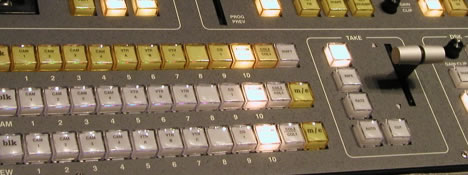
Between all of this was a towering contraption about three-feet-square, maybe five-or-six-feet tall, and on wheels. I laugh when mentioning the wheels as I vividly recall someone trying to move the monstrosity to retrieve a fallen paper and having no luck: the wheels were either jammed, worn down, or just for decoration. The reason didn’t matter. This was the video switcher.


There were two main components of the switcher, or mixer as it was sometimes called:
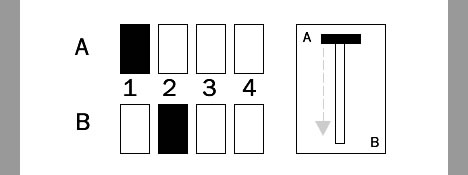
  • The bus, essentially a row of buttons indicating various inputs (e.g. camera 1, camera 2, VTR [video tape recorder], etc.).
  • The fader bar, what was used to create transitions between the two busses.
Let’s make this easy by using the equipment in Studio 3 – essentially the only equipment: Camera 1 and Camera 2 – and shoot a conversation between Rachel and Brad. On the mixer bus we’ve indicated our inputs with camera 1 punched up in Bus A and 2 in Bus B (see graphic). There was a preview monitor for each input and both Brad and Rachel were properly framed and in focus: camera 1 has a shot of Brad facing left and camera 2 has a shot of Rachel facing right.

Cue talent.

In the simplest of mixers, whichever bus the fader is delegated to is active and directed toward the output source, or program monitor. On the switcher the A bus is active and the monitor shows Brad. Brad asks Rachel a question. The director instructs a switch to camera 2; this is done by the switcher operator moving the fader bar down to the B bus. Now the B bus is active; the monitor shows Rachel.


The program then continues going back and forth and viewers are subject to some sappy story of Rachel and Brad trying to rekindle their relationship. Or something like that.

The transition between the two busses varied, as it could be a swap between the two inputs (i.e. a “cut” or “take”) or something a bit more elaborate, such as dissolves or fades or the dreaded wipes. Wipes came in numerous forms: star-shaped, heart-shaped, or iris-shaped, which was a growing or shrinking circle. In all the studios in the Communication Building, as well as in all the television production rooms, were graphics machines that enabled text, basic graphics, and a compendium of wipes.

Dr. Propel hated wipes to the point that he instructed to write down one of his cardinal rules: “Wipes are cheese.” Wipes were nothing more than cheesy effects that were overused and perpetuated by those incapable of original thought. Our wipes were pretty cheesy: there was a cow wipe (the image of a cow grew to fill the entire screen with the second input), the rolling dice wipe (two die are rolled from the center of the screen, grow larger, and the second input image is seen in the dot as the cube comes closer), and the mildly-popular Peeping Tom wipe (a woman walks by an open window, is shocked to see someone peeping in, and she pulls down the curtain that reveals the other input).

In short, wipes were as cheesy as some of Propel’s jokes and mannerisms. That, and the switcher was relatively easy to use.

Now we just had to take what we learned after using all the equipment and apply it to usage outside the classroom.

That meant the radio station. Fun times were just ahead.

- - - - - - - - - - - -
Switch
(Engine Alley)
Engine Alley
From the album Engine Alley
1994

At the no go show you can stay all day
You won't know no no what to say
If it's a radio show it might be better that way
There's too many people with nothing to say
You can go, you can go
Radio show Radio show
You can go, you can go

I switch on the rayjo (at a quarter to 12)
And then I switch off the rayjo (at a quarter past 12)
When I switch on the rayjo switch! switch!
I have to switch off the rayjo

At the no go show you could stay all day
You didn't know no no what to say
It was a radio show and it was better that way
There's too many people with nothing to say
You can go, you can go

I switch on the rayjo (at a quarter to 12)
And then I switch off the rayjo (at a quarter past 12)
When I switch on the rayjo
And when I switch off the rayjo
Switch! Switch!
When I switch on the radjo
I have to switch off the radjo Ho Ho

Sunday, October 19, 2008

Living Room Camera

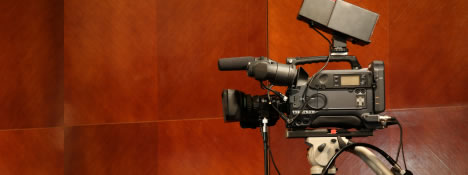
Zoom, Truck, Tilt, and Dolly
Now Pedestal and Pan
Silence in the studio
For the dancing camera man.

Midway through the semester, the Introduction to Broadcasting course switched gears and the focus went from audio to video. I remember a few people later commenting that they “liked the radio portion” of the course better “than the television.” This was sort of a misnomer, as that part of the class really didn’t focus on “radio” more than it did on “audio.” The idea, of course, was to use the lessons learned from audio production and apply them to video production. As Propel noted, “Unless you’re going into silent film, then the audio portion of the class was a waste.” Typical Propel humor.

Then, too, the discussion changed in our hands-on lab course...though I just noticed, all these years later, that the class maintained the name “Radio Workshop” even though we now met in Studio 3.

Ah, Studio 3 – such an appropriate name. You’re familiar with the comparative list “good, better, best” I’m sure. Studio 3 in the Communication Building would be the “good” of this list, though the loosest sense of the word “good” and the epitome of “third best.” I don’t know if it had been built for anything other than a training area because it was too small and too under equipped to serve in any other role. When we walked in the first time I was amazed at just how little there was: two studio cameras in the center of the room, a semi-circle of chairs around one wall, a small table that held the light controls, and decorative squares of soundproofing. Master Control for Studio 3 was in an adjoining room and was just as a sparse – some rudimentary machinery and a few more of that hard plastic swivel chairs similar to the ten or twelve in the studio.


Learning how to move the camera was the obvious lesson. To that end, our off-the-wall instructor had taken the time to put together a game in the studio that looked similar to dance steps one finds on the floor or a flowchart. I don’t know if this was something he prepared for earlier this semester or if it was a holdover from previous years, but I quickly got the impression it was not something new.

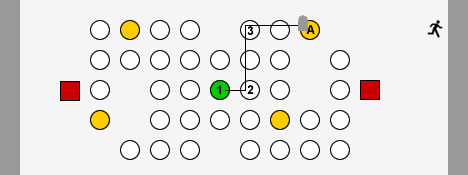
The rules were simple: there were between 40 and 50 circles fastened to the floor. One circle was green and this was where the student operating the camera would start. Another student, acting as director, sat in the control room and instructed your next move. The goal was to get the camera to one of the red squares on the floor. That seemed easy enough except Dr. Propel had changed four of the circles from white to yellow and you had to maneuver the camera to each of these four circles before you could touch a square (the yellow circles were interchangeable such that every student had a different path each time he or she played the “game”).

The instructions given by the director were either “to dolly” or “to truck” the camera.
  • To truck” the camera meant moving the camera tripod or pedestal to the left or to the right. The camera mounted to the tripod or pedestal does not move. The instruction “truck 1 to the right” would take the camera from Circle 1 to Circle 2 on the graphic.
  • To dolly” the camera meant moving the tripod or pedestal forward or backward. Like trucking, the camera itself does not move. The instruction “dolly in 2” would take the camera from Circle 2 to Circle 3 on the graphic.
Dr. Propel wholeheartedly supported erroneous instructions such as “truck out 4 spaces” or “dolly left 2 spaces” to see who was paying attention.


What instruction was given to get the user from Circle 3 to Circle A?

At the yellow circle (Circle A) Dr. Propel took over with the instruction:
  • Pan: the horizontal left-and-right movement of the camera; the motion was comparable to someone shaking their head “no.” The tripod or camera mount remained motionless.
  • Tilt: the vertical up-and-down movement of the camera; the motion was comparable to someone nodding their head “yes.” The camera mount also remained motionless.
  • Pedestal: the vertical up-and-down movement of the camera tripod; the motion was comparable to someone standing on tip-toe whilst looking straight ahead.
  • This leaves zoom, a control on the camera itself that allowed us to “zoom in” to obtain a closer view of something or “zoom out” to obtain a wider, more distant view.
So at Circle A Dr. Propel might say, “Pan right and zoom in on the picture of the man running.” We would then swivel the camera to the right – making sure to not move the tripod – and then zoom in on a picture Dr. Propel had taped to the wall. “Now, tilt up and get a shot of the ceiling.” That was easy. “Now pan down and zoom in on one of your classmates.” Okay, so...wait – you can’t ‘pan down.’ So we were paying attention...we were passing the test.

So the student director trucked and dollied the camera operator to another yellow circle where again Dr. Propel would bark through a series of orders. The idea was to give the instructions and make the movements as quickly as possible, as if we were shooting an action scene of some sort.

It made for some interesting classes at first, but, as one could imagine, it got old fast – especially when we all expected Propel’s incorrect instruction and moreso his giddy laugh when we were on to him.

- - - - - - - - - - - -
Camera
(Jerry DiRienzo)
Cell
From the album Living Room
1994

Sunday, July 20, 2008

You're so warm, oh, the ritual, when I lay down your crooked arm

If there’s “LP” on its label
Spin the disc on a turntable
Drop the stylus on the grooves
RPM - how quick it moves.


I was surprised at just how much vinyl there was laying around when I was an undergraduate. Yeah, there wasn’t as much of it as there were compact discs, but still there was more than I had ever seen and it was one of the few mediums I recognized. Like most kids my age I had a record collection growing up but, unlike most of the kids, mine had zilch in the way of popular music and consisted more of stories read by Danny Kaye or soundtracks to kid-themed television shows or – my very first – a bizarre exercise in customization with a ridiculous song that repeated my name, or its closest equivalent, over and over. I can still hear echoes of “Martin, it’s ja birth-a-day” to this day.

But everything before college was “records” and now I got to identify those blacks discs as that: discs. Also frowned upon was calling the playback device a “record player,” as it was in truth a turntable and made of more stringent stuff that your home version. But the concept was the same: the discs are placed up on the plate, the tonearm is moved into position, the stylus is cued to the proper track of the disc, and – voilà – you have sound. Contrary to what we were told by the Criminal Element Orchestra, the cartridge did not contain a needle to drop upon the record; rather, the stylus was made of diamond and the vibration of the stylus was converted into an electrical signal through the process of transduction – which I see from my notes was a vocabulary word on one of Propel’s quizzes.

There were a few things students had to be careful with when it came to using the turntable. First was the speed. Young music fans will find nothing notable about the numbers 78, 45, and 33, but these numbers corresponded to the revolutions per minute (rpm) of the phonograph record. Most of the albums we had in the studio were LPs that required playback at 33 1/3 rpm; they could be made to sound like Alvin and the Chipmunks if played at 45 rpm. This was something we had to learn to pay attention to as early as our practicum labs with Dr. Propel, who enjoyed nothing more than fiddling with switches and knobs for our hands-on quizzes. The instructions would be to play the turntable “on air” in one of the production rooms. While the student might flip all the switches on the console correctly, if she or he forgot to check the turntable speed then you knew that Propel would be sitting with his half-tooth grin and chuckling for being able to pull one past you.


Secondly, students had to know how to properly cue a record. Keep in mind that the turntable sat stationary until the motor was activated; only then did the plate that held the disc begin to move. If the turntable could not get up to its proper speed before the sound began then there was often an odd noise known as a wow. I suppose, if I needed to write out the description, one could say it sounded like someone talking in slow-motion that rapidly sped up to normal. To prevent this wowing noise, the user had to set the stylus on the lead groove preceding the desired track and then spin the plate (and record) until the exact spot where the sound begins is pinpointed. From here the user spun the plate counterclockwise about a quarter turn or so and then waited.... When it was time to play the track, the DJ made sure the audio console was ready and activated the turntable. Once powered-up, the turntable spun the plate with the disc, the stylus transferred the vibrations on the disc into an electrical signal, something else I’ve probably forgotten to mention happens, and finally the amplified sound is broadcast over the air.

And, if you’re lucky, the disc isn’t scratched. I suppose that could be the third problem with records – when previous users didn’t handle them the best they could sometime receive irreversible damage to their surfaces.

Our main studio had two turntables, neither of which was in regular use by the time I showed up. Most records had been phased out of the control room by my junior year and those that weren’t permanently borrowed by students usually got shuffled from one production room to another in someone’s attempt to get them out of sight. A few of the “good” ones that showed up in the Music Library at one point were The Blue Album of Beatles hits; a 12” single of a Whitesnake song; some David Lee Roth, David Bowie, and Iggy Pop solo albums; and volume 4 of a 10-piece sound effects set. When the studio was remodeled a few years later one turntable was removed.

Once in a while something new showed up – a Beck single here, a Sean Lennon single there, and more than enough R&B remixes – that required a turntable and the DJ on duty had to recall his or her turntable etiquette. Most people shunned away from using the turntable but there were a handful of people that enjoyed dusting it off now and then. For example, when I had to fill in on a Friday night (9 pm to midnight) shift for a month or so my senior year I usually concluded my three hours with the “final vinyl.” I always assumed that no one cared the song was on vinyl but I thought it was cool. In fact, the only person who probably thought it was really cool was Joseph “Joey” Jones, the commercial radio geek-fan who took surveys of radio stations to get find out how many still “cued the disc.”

“Cued the disc.” Man, I always thought it odd when he said that.

- - - - - - - - - - - -
Spin the Black Circle
(Pearl Jam)
Pearl Jam
From the album Vitalogy
1994

See this needle...a see my hand...
Drop, drop, dropping it down...oh, so gently...
Well here it comes...I touch the plane...
Turn me up...won't turn you away...

Spin, spin...spin the black circle
Spin, spin...spin the black, spin the black...
Spin, spin...spin the black circle
Spin, spin...whoa...

Pull it out...a paper sleeve...
Oh, my joy...only you deserve conceit...
I'm so big...a-my whole world...
I'd rather you...rather you...than her...

Spin, spin...spin the black circle
Spin, spin...spin the black, spin the black...
Spin, spin...spin the black circle
Spin, spin...whoa...oh...

You're so warm...oh, the ritual...when I lay down your crooked arm...

Spin, spin...spin the black circle
Spin, spin...spin the black, spin the black...
Spin, spin...spin the black circle
Spin, spin...
Spin the black (5x) circle
Spin the black circle... (4x)
Spin, spin... (6x)

Sunday, June 22, 2008

AEIOU's an ass-whoopin'! You're tooken into clear and present danger!

The eighth (but not quite final) member of the Octumvirate was a weird, wiry kid named Kenny Jones who showed up for meals only because he was the suitemate of Alan and Michael Arthur. One could make the case that Kenny looked like a living caricature of Stan Laurel with rubbery facial features and a pronounced chin. Rarely appearing for lunch, Kenny’s appearances were usually regulated to dinner where he just sort of ate, listened, chimed in occasionally, and then departed.

All these years later, Kenny is remembered for introducing the Octumvirate to the ancient martial arts style known as Shaquido. If that sounds made-up, it is. Most of the Octumvirate followed some professional football and basketball team to some degree and one of the big names at the time was the new guy playing for the Orlando Magic, Shaquille O'Neal. Besides his athletic prowess on the court, O’Neal jumped on the celebrity oversaturation bandwagon and released albums, appeared in movies, and approved his likeness for release in a video game. The game, the cringe-worthy Shaq-Fu, focused on O’Neal using his supposed martial arts abilities to ward off evil-doers from his dojo and protect the sensei. Or something like that, I dunno.

Anyway, Kenny found the whole notion of a Shaq-inspired video game ridiculous and arrived at dinner one night with Shaq-Fu trading cards. One of his video game magazines had a bigger-than-necessary promotion for the game and Kenny, eager to expose Shaq-Fu for its sheer lunacy, had punched out the cards as “gifts” for those of us who wanted to share the Shaq-Fu experience. The obverse had the official Shaq-Fu pose and logo, while the reverse explained the concept behind the game:


A dominating force on and off the basketball court, Shaq is the founder of Shaqido: an intense and extremely advanced form of martial arts. An enforcer of justice and champion for the weak and powerless, his blows rain down destruction on those who embody pure evil. Shaq is a short range specialist who relies on his agile moves rather than his magic. Shaq’s favorite closing move is the Shaq-uriken. Here he summons up a whirling blade which attacks evil with devastating force.

All these years later it still doesn’t sound believable.

I probably made Kenny happy when I jumped on the “Ridicule Shaq-Fu” campaign. Everyone had a good laugh at the cards, but I seemed to be the only one who took one of the cards back to my room. Why I hung it prominently above the door I don’t know. Nor do I know why I joined Morty, Michael Arthur, and Kenny for an evening of driving around town a number of weeks later. We’d been studying well into the night and now, hours after dinner, our stomachs craved a little something more. That night it meant we’d be hitting up Señor Taco, a sort of cheap, local spin on Taco Bell (they had this green sauce that was legit but not much else going for it). Seemingly high on ridiculing O’Neal, we pulled into the drive-thru. No sooner had we stopped did I ask the voice on the speaker box if they had Shaquidos.

Come on, it sounded like the sort of pseudo-Spanish names that Señor Taco gave their menu items, foodstuff such as Enriquichos or Grañdatas or the El Guaposita.

Kenny’s only other memorable claim to fame was showing up one day at dinner with what looked like a black magic marker that he had used to color his lower jaw. Most of us either stared inappropriately or tried to ignore the strange discoloration until either Alan or Michael explained Kenny was attempting to grow a beard. It was not an attractive addition to Kenny’s face and during that first week he’d try to nonchalantly bring it up into conversation or stroke it as if in deep thought while he sat on the sidelines listening. It was fairly thick in places which sparked theories of lycanthropy from Phil; this in turn prompted Alan to encourage his suitemate to drink more Coors and I suggested heavy doses of Bob Seger and the Silver Bullet Band.

The members of our Octumvirate went their separate ways after my freshmen year though a few of us saw each other over the next three years. Not so much with Kenny. His appearances were rarer and rarer as the school year went by and was a distant memory by the start of a sophomore year. No one knew where he came from and no one knew where he went.

And no one went off in search of him either. Him or that video game.

- - - - - - - - - - - -
No Hook
(Bailey, K./Method Man/Shaquille O'Neal/RZA)
Shaquille O'Neal
From the album Shaq-Fu: Da Return
1994

[RZA:]
Spectacular cardiovascular attacker!
Shaq's on the track with the blackular,
Puzzler! Rugged slugger, 40 oz guzzler,
Gold nugget fangs punch holes inside your jugular
Veins... do it quick, before your brain get drained...
With the horror you now have become stained...
Ice cold, like the winter, Eskimo! Enter,
The skill like a splinter! A decimal,
Let's have a festival, Wu-Tang Killer Bees, we...
(Suuuuuuu!) Ah, intellectual,
Styles break your mind!
Shine, nigga, shine!

[All:] We don't need no hooks!

[Shaq:]
The Shaq Attaq has risen,
Au concrete PM this is twizm,
Always & forever, forever always attack,
I bring flava to ya ear like Craig Mack!
Life's a B and then ya D, refer to Nasty Nas Illmatic,
CD, #3 Static!
You don't want none, ya best to keep lookin',
AEIOU's a ass-whoopin'! You're tooken
Into Clear & Present Danger, I'm a perfect stranger,
Quick to rearrange a... outlook, so look out,
So here me comes! Quick to beat you down,
Like the RZA on the drums!
Change my name like Prince, punks be tremblin'.
My name ain't Shaq no more, call me Superman
Emblem! Marks, get set, go left,
The Shaq, the RZA, get ready for the Meth!

[All:] We don't need no hooks!

[Method Man:]
Dangersome, comin' mad phat, Terrordome,
Like whadva ak, we can get it on. Break 'em down.
I'm a set it, yeah, ooh dat dirty rat, bring 'em here
To the mindbender, the deathsender to your ear: Method.
Whatup, hookers? Hoodrats are no goodaz,
It be Tical breakin' rims with the Seven footer:
Shaq. Bring it to the front, now bring it back
To the head, black, 'cuz when my Soul Train hit the track,
Target: the Billboard Charts, don't make me start it,
The whole industry is gassed up and now they farted.
My object is destruction, for percussion, rhymes are bustin',
Got your wholes block duckin'
Down! The end is here, apocalypse now!
Gettin' shot, peace'll work it out.

(more We don't need no hooks stuff)

Sunday, June 8, 2008

What's an Irish Boy with a good family doing in the gutter?

Five students from Bowman Hall made up the majority of the Octumvirate. The remaining three students lived down the hill from Bowman Hall and around the corner to the west in Rex Hall, one of the four-decade old housing units cobbled together after WWII. It was a male-only dormitory which probably led to the musty dankness that emanated from the half-underground first floor and spread upward through its four stories. It was a sobering experience for visitors to manage through their initial five or ten minutes and I can only guess how students who lived there ever persevered. One minor bit of hilarity that I found in the residence was that the hall mascot – apparently some held-over concept from the 1950s or 1960s, sort of like housemothers – was the lion (presumably stemming from the Latin rex, meaning king, and in turn referencing the king of the jungle). The catch here was that the masculine mascot was for a dorm named after the very feminine Blanche Rex, some former administrator from the past. She might have gotten a kick out of the dorm named after her but I doubt she would have liked the smell.

Leading the charge from Rex Hall was Alan Heathland, a normal looking guy in most every aspect. I recall mostly normal features with beady eyes and greasily-styled hair. Alan grew up down south in Port Wright which was about a six or seven hour drive from where we were. Thankfully for him he had an uncle and aunt living about thirty miles away that invited him out to their country club-like estate for weekends. Of course, Alan in turn invited his friends out a few times a month to cook on the outdoor grill, swim in the outdoor pool, and get out of the usual college setting. Or so I was told.

What stands out a decade later about Alan was his accent, something that Stan once said “sounded Peruvian” which in turn led to Stan and Phil bantering back and forth in a sidebar conversation about the merits about Machu Picchu. For whatever reason Alan never talked much about his background or family so most of us just let the matter drop. Not Phil, whose natural curiosity about everything kept him asking occasional questions trying to get Alan to drop a hint or two about his upbringing. His initial questions were not always tactful (“So, where are your people from?”) nor always understandable (“Sua mosca está aberta?”) but it was fun watching his mind wrestle for clues in whatever Alan said.

This went on for a few months before Phil quit guessing and finally said he had figured it out. “You’re Irish,” Phil announced one night at dinner. Alan, who all through this time had been a great sport about Phil’s questions, simply shook his head and said no, he wasn’t Irish. Phil didn’t seem to come to terms with Alan’s “no” and said to hell with that: “well you sound Irish to me. You’re Irish.” Thus Alan’s new nickname – Irish – was born, which lasted the rest of the semester and into the following spring term.

Irish became part of the Octumvirate because he and Leonard were in a class or two together. In turn Irish brought Arthur (his roommate) and Kenny (their suitemate) with him to dinner and all three were welcomed. Most of this crew from Rex Hall disappeared during my sophomore year. Perhaps Alan moved out to his aunt and uncle’s place to live out the rest of his college years?

Right.

- - - - - - - - - - - -
Irish Boy
(Sanchez)
Paul Sanchez
From the album Wasted Lives & Bluegrass
1994

Sunday, March 9, 2008

ooee girl and there really ain't no time to waste, really ain't no time to hate

Leading the kick-off meetings held each semester was the Program Director (PD), an upperclassman that the faculty advisor thought demonstrated the knowledge, skills, and ability to oversee the day-to-day operation of the station. The PD would be the student with final say on the sound of the station as far as music, production elements, and other content was concerned, and would critique students during and at the end of the semester (i.e. grading). The PD was, in essence, the boss.

The PD for my freshman year was Helen Miles. I have absolutely no recollection of Helen now and I would have forgotten about her by the time I stepped into the PD role four years later had it not been for pictures of student management from previous semesters hanging on a wall. I'm sure she was at the kick-off meeting and I'm sure I may have been introduced to her, but since I only did news in the early morning hours I’m sure our paths must not have crossed much.

She would have busy, though. Even though the position was held by a student, the position didn’t bend to accommodate so-called “student time” – the radio station was on the air 18 hours a day, seven days a week, and the PD was responsible for it all.

On average the PD put in 16-20 hours each week, but in horrendously irregular and inconsistent shifts. Somewhere in there Helen probably had regularly scheduled office hours, in which she maintained the program logs (a record of what non-musical items were played and when); the transmitter logs (a record of the transmitter readings); and the Public File (a series of documents maintained about the station’s programming and operations, as required by our friends in Washington – the FCC).

Other duties included developing the semester schedule based on input received at the first meeting; training the announcers (thankfully with assistance from the other directors); scheduling vacancies when announcers don’t show up; attending the weekly management meetings (essentially a meeting of the “class” that student managers enrolled in); as well as a number of other tasks. Above all, the PD monitored the station for programming quality and professionalism.

The position was almost always bestowed upon a senior, a fitting way for someone to be rewarded prior to graduation for all the time and effort he or she had committed in years past. Likewise, the tenure of all the directors (Program, Music, News, etc.) was one school year (two semesters); however, for a number of off-the-wall reasons, the Program Director position fluctuated each semester while I was an undergraduate.

Let’s see...I think six bosses in four years.

That’s a lot of boss.

- - - - - - - - - - - -
Boss D.J.
(Sublime)
Sublime
From the album Robbin' the Hood
1994

there's a steel train comin' through
i would take it if i could
and i would not lie to you
because sunday mornin' soon will come
when things will be much easier to say
upon the microphone like a boss dj
but i won't walk up upon the sea like it was dry land
a boss dj he ain't nothin' but a man
no trouble, no fuss, i know why..

it's so nice, i wanna hear the same song twice
it's so nice don't wanna hear the same song twice

rumors are spreading all over my town
but it's just stones and sticks
upon the microphone is where i go to get my fix
just let the lovin' take a hold cuz it will if you let it
i'm funky not a junkie but i know where to get it
no trouble no fuss i know why

it's so nice i wanna hear the same song twice

oooee girl
oooee girl
oooee girl

ooee girl and there really ain't no time to waste
really ain't no time to hate
ain't got no time to waste, time to hate
really ain't no time to make the time go away

so mister dj don't stop the music
i wanna know
are you feelin' the same way too?
i wanna rock it wih you-oo girl,
you-oo girl, you-oo girl, oooooo
mmmmmhmmmhhmmm
don't stop

'cuz it's so nice i wanna hear the same song twice
it's so nice i wanna hear the same song twice

nowadays all the songs on the radio they all
all drive me crazy

Sunday, January 27, 2008

The Newsroom 7:00 P.M.

During that first semester on the air, doing news at seven o'clock in the morning and pretending to enjoy now being a morning person, I was under the direction of the station's news director. Like most other station leadership positions, a student filled the role of news director; that semester it was Troy Meadows. I don't remember much now about Troy all these years later except that he took the news business fairly serious. That is, he expected something newsworthy to come from our brief newscast but wasn't gung-ho enough to require us going out and delving into anything local. And he was tall – sort of looked like Jim Gaffigan. I don't think it was the same guy. (It wasn’t. Sorry.)

The "newsroom" was the term usually used to refer to one of two rooms in the building. One room was mainly geared toward putting together the newscasts for the television station, but radio staff was allowed to work there. Even all these years later that seems like a trivial point – that students from two different mediums were permitted to use a common room for a common purpose – but I recall during my sophomore stint in news that the television people were a bit touchy about non-television people using the room. Arrogance was at fault, mostly, as was stupidity – seeing how it was often the same students.

There was nothing really newsworthy about this room, except that it still had an AP wire machine in a back closet (frankly, that isn't newsworthy either). The closet was large enough to house the printer (on an ugly faux-Victorian stand without a doily) and that was it – maybe a box of paper could be edged in the back if you propped it just so. During my freshman year the closet was unlocked and the wire service was used; in my later years the door was always locked and was the topic of occasional conversation. I remember getting some strange looks once when I told some people what was in there. At another point, a student was all but sure there was a ghost haunting that end of the building, near the newsroom and by Ms. Ganslape’s office. Perhaps it was just the AP machine, long empty of ink and paper but still able to receive the day's news.

I don't know what purpose the room had been created for – it was too small to act as a classroom, and was too large to be an office for one person. Perhaps in the original plans it was designated as a true "newsroom." It looked more like the surplus room, as excess full-size desks and file cabinets (none matching anything else) were dropped off over the years, leaving certain (television) students to appropriate their "area." There was also a beat-up, yet usable, television in the room that usually was able to only receive the stations you didn’t want to watch at that moment (someone once called it a “Zenith knock-off” but I can’t say).

In my later years, after those students who felt they had sole ownership of the room graduated (or had at least disappeared through other means), the room was used by radio and television staff without incident and almost became sort of a pseudo-lounge for students. During the day you could often find someone catching up on reading, studying, or picking apart something for lunch; after hours, when students reserved video bays for overnight editing, the “newsroom” truly became a place to relax, take a break, and catch some sort of late night television (Tom Snyder being a frequent choice).

There was another room in the building dubbed the “newsroom,” but it’s down the hall and I don’t want to walk that far right now. We’ll hit it up later. I’m goin’ to crash here – catch some ESPN or somethin’.

Later.

- - - - - - - - - - - -
The Newsroom 7:00 P.M.
(Newman)
Randy Newman
From the original motion picture soundtrack Paper
1994

Sunday, January 20, 2008

My head is spinning round+round you pick me up then push me right back down

Sitting somewhat between the College Memorial Library and Bowman-Oates Hall was the Communication Building, constructed at some point between the 1970s and 1980s. It was just over a decade old by the time I arrived (approaching fifteen years, maybe) and therefore in certain nooks and crannies still had that new building smell. As time went by, the building went from being a strictly classroom building to one where I – as well as a handful of other students – lived, worked, ate, and, once, slept. I don't recommend sleeping in a classroom building.

The Communication Building was constructed on the site of the old Eleemosynary Building. A boxy, cream-yellow brick building, it was unclear whether the Eleemosynary Building name was colloquial or official, but it was the only name the building was remembered by in the 1990s. Don’t for a minute think that the building was remembered fondly a decade after its removal – it wasn’t. It remained in memory only because there was an aerial photograph of the old quadrangle in the foyer of the Communication Building with a note explaining what had since been removed. The old Eleemosynary Building was demolished during a time that the administration discovered they had a lot of aging, sagging, and weary looking structures and presumably decided to put them out of their misery. Once most of the historic and beautiful eyesores were removed, empty lots were created on most of the property, with the unusual decision to build something at the southern end – and thus the foundation was set for the Communication Building.

Inhabitants of the building during my time liked to point out the ironic lack of communication between the instructors, the classes, and the competing programs housed within the building (i.e. the Communication and Journalism programs). Early inhabitants, however, had their own tale to tell, specifically the lack of communication in getting the building off the ground, or at least out of the ground. The original four walls each was built and then rebuilt at least twice because of a combination of faulty supplies, air pockets in the concrete, and someone's insistence to not use a straightedge. Assembly continued once the walls were constructed properly and sat perfectly perpendicular.

Let's take a walk around inside, shall we?

Broadcast studios for both the radio and television station were located prominently on the ground floor of the building, easily noticeable and accessible when you walked in the north entrance. As a freshman, this would be my first time around a radio station. Prior to this I only had listened to radio stations, had seen pictures of radio stations, and watched bits of pieces of some radio stations on television programs. But I had never actually seen a radio station up close and personal and likewise never set foot inside one. Therefore my introduction to the control room was a little daunting – while it was a little exciting to see one working up-close at the same time it was a little nerve-racking to know that students were responsible for everything that went over the air. And I was a student.

From that north entrance clockwise along the outer wall (following the trail of two-tone Berber carpet) were faculty offices, the mid-sized television studio, a staircase to the second floor, the small-sized television studio, a seldom used "production room," the elevator, and then a deep closet of electrical equipment few students ever saw. Turning a corner and down a long, dim hall were the first of four small audio production rooms along the eastern wall, a small classroom, and something called the "newsroom." Turning the corner again into a shorter hallway along the south wall were three or four faculty offices. This exited out into another long hall: one direction took to you to more stairs and more faculty offices, including the department head, and the other took your back to the north entrance. The western edge of the building housed the large television studio, which was more or less home to all the programs on Community Channel Seven.

The radio station, then, was in an island of smaller rooms and offices in the center of the floor. FM 89's main studio had two large glass windows looking out to the north and west; to its immediate south was something else called the "newsroom," and the aforementioned Music Library (see It's like you're always stuck in second gear). The rest of the "island" had production rooms or offices, accessible from either the main western or eastern hallway.

It was the main studio that was really where it was at. It grabbed your attention with the two panes of glass, drawing your gaze inward at the DJ on duty, sitting amongst all the various equipment – a cartridge machine, some CD players, two turntables, and a microphone. Just clap your hands, clap your hands.

- - - - - - - - - - - -
Communication
(Jeff Ott)
Fifteen
From the album Choice of a New Generation
1994

Where have all the good times gone, when we were together, and life was fun
I wanted to give you the Moon and the Sun, and share my life with someone
I didn't want to change your life, I just wanted affection, not a wife
I didn't want to steal your individuality, and it wasn't just about sexuality
I used to think of your smile to myself
But now my life's a guessing game
Communications, broken down, Communications, broken down
My head is spinning round+round you pick me up then push me right back down
I just wish things could be the same, I know they can't go on this way
Sitting here on my birthday, wondering what can I do or say
To bring your friendship back my way, A million times I want to say
If you didn't feel so far away: I'd be picking flowers for you again today
But if you leave me in the dark today: I'll just have to be on my way
Hoping, you'll follow, my trail of tears, to work things out someway

Sunday, December 30, 2007

Don't want a conscience, give me a reason the people cry

Let's run through some of the peanut gallery in the Introduction to Broadcasting course, shall we?

I've already mentioned Lanna Sexton, one who I liked to refer to as "the loud one" as she frequently announced her presence, her abilities, and her opinion. She was a short, dumpy troll-like girl that really caked on the makeup in those gaudy hues no one had ever seen before. Now that I'm committing her vague memory to text I sort of wish I had paid more attention to what she yammered about all those years ago. She was a bit older than most of us and had worked as a receptionist at a television station "back home." Somewhere along the road of that profession she decided she had what it took to work in front of the camera, though I can only assume this idea was not mutually shared by those in charge of programming. Perhaps she came to college to prove she had what it took? Her overall goal was to get on television and not sit through these classes but while she had "heard" about some of the things discussed in class, she couldn't explain them no matter how hard – or how loud – she tried.

Keith Holland was another person who looked a bit older than most the rest of the class, but not by much. His most recognizable feature was his voice, evidently having picked up a nicotine habit earlier in his life. Like Lanna, he too had worked in the "industry" though his background was actual radio work – he was a weekend DJ at some backwater pop station. While that hands-on experience did give him a certain edge over the rest of us, Keith's major hurdle was unlearning some of the murkier traits he had picked up from his paying job. Instructors such as Dr. Propel and Dr. Schapp tended to teach the fundamentals in the lab practicum courses and they wanted to make sure everyone – even Keith – understood the concept behind a procedure before attempting short cuts.

For most of the year I sat next to the attractive but clinically dense Ivy Rovers. With a pleasant, wide-eyed face that was looked perpetually amazed at every mundane thing that happened, Ivy assumedly signed up for this major because she thought it would be easy. I got the impression on more than one occasion she found herself wrong for that initial thought and was now in way over her head with radio wave diagrams and lighting technique theories. However she had nothing to fear: her sorority sisters would be bailing her out of any mishap.

There was also Stephen Cornell, a sort-of flamboyant kid with a flair for dramatics and who looked like singer Rick Astley's twin brother. Sitting in class, listening, Cornell would nod slowly with exaggerated motions at whatever was being said. More often than not this would then be followed by what I think Stephen perceived as questions, but were usually smart-ass reinterpretations of what Dr. Propel had just said.

(This conversation didn't happen but it gives you the idea of those that did.)
Propel lectures about the cardioid pickup pattern of a type of microphone.
Cornell raises his arm, extending his index finger to signal he requests the chance to speak.
Cornell: So you're saying the microphone picks up sound in a heart-shape pattern?
Propel answers yes without much fanfare, presumably masking his disdain.

I've never cared much for people who act over-interested in what's being said. It comes across as fake, or being sincerely insincere. Even with this penchant for overacting, Cornell never seemed to me to grasp a lot of what was going on – or he convincingly played dumb a lot during the practicum lab.

Finally, th’ Faith Healers were a underground pop act out of England in the early 1990s that featured musicians Tom Cullinan, Joe Dilworth, Ben Hopkin, and Roxanne Stephen. While they had class, none were in the class with me or the other four people I’ve mentioned above. The only real similarity is that, like the group of not so-imaginary people (none really friends), we’ve all broken up and gone our separate ways.

And what weird, wonderful journey it’s been.

- - - - - - - - - - - -
The People
(Tom Cullinan)
Th' Faith Healers
From the album Imaginary Friend
1994

Mother cries
when the people dies
I understand
I hold her hand

The puppet cries
when the people dies
I understand
I hold his hand

The people cries
when the people dies
I understand
I hold their hands

The people cry
when the people die
I understand
I hold their hands

Don't want a conscience, give me a reason

Sunday, December 2, 2007

Pop Quiz

The Introduction to Broadcasting course (see Broadcast) was sort of divided into two halves, with one half of the semester geared toward audio production and the rest of the year devoted to television, although there was of course some overlap. Naturally the audio elements were presented first – as a foundation – as it was understood (by most) that the later details of video production would be built on the earlier lessons of the semester.

This, then, would be a good place to briefly introduce Lanna Sexton, one of the obnoxious prima donnas of the class, who made it known she felt her attendance was an oversight and she was just ready to get her degree in television (i.e. radio was beneath her). We'll discuss some more about her later on.

The course began with Propel's introductory chatter about radio and television production in general. From there it was lessons on dayparts and target audiences (enter new word: demographics) and so on. The following week or so, when most of this seemingly basic and unnecessary information was dissipating, Propel decided to make good on his threat from the syllabus (enter another new word, for those new to college...).

I've noted some of Dr. Propel's classroom quirks (e.g. EBS threats, video montages); another such trait was his penchant for the unannounced pop quiz. The syllabus said to expect them anytime, be it any day of class or any time during class (nothing soured the morning more than getting through the first hour and ten minutes thinking we were home free and having him end class with a 20-question quiz). Propel usually segued from attendance or the lesson right into the quiz, with little fanfare; the only hint was his whimsical announcement, "It's time for a quiz."

After a brief pause, in which time Propel would contort his face into an impish grin of delight, we were then given a simple directives: "Take out...two...sheets...of pay-pah!" The phrase was known building wide and parodied often. The ridiculous stress on the word "two" and the silly pronunciation of the word "paper," plus the fact we heard it weekly, left an imprint on many people's psyche. Long after he had left the department people would still crack a grin when someone tried to do a Propel impression.

And what of the quiz? We were the Pop Quiz Kids, speedily moving about to get out our two pieces of paper (one to write on, the other to cover our answers) before he began asking questions because, as we learned, a question was only asked three times. He asked twice in the course of the quiz and if someone missed a question he would recite it once more. But never four times would a question be asked.

One of the first quizzes was asking the class to give our individual interpretation of the word "broadcasting." Most everyone had an answer that dealt with audio and video signals dancing across the ionosphere or something media-related. If memory serves, only one (or a scant few) knew the somewhat-dated definition involving seed scattering. Naturally, even while the curriculum discussed mass media and so on, Dr. Propel only wanted the archaic answer about seed scattering.

Such was the way of Dr. Propel.

- - - - - - - - - - - -
Pop Quiz
(Mark Mancina)
Mark Mancina
From the album Speed: the Original Score
1994

Sunday, November 4, 2007

Broadcast

Introduction to Broadcasting was a 100-level course (COM 136) that was supposed to be the first class you took as a communication major in the communication building. I only point that out now because it didn't work out that way later for someone else. But that's another story.

It was an introduction of many things for me, notably the dual distinction of being my first class – first ever at college and first ever in the communication building. It was also my first of many classes to commence at eight o'clock in the morning. It was a three-hour lecture course offered at varying times that semester; I signed up for the session that met Tuesday and Thursday mornings from 8-9:30. Yes, I was a freshman and didn't know better (I like to think I had a scheduling conflict and had no other choice but who knows...).

The course (casually referred to either as "I2B" ["eye-two-bee"] or "'tro" [short for "intro"] by those people who thought it sounded hip but were, in fact, the tragically unhip) met in room 321, probably the largest classroom in the three-story building. For years I thought it was the only classroom in the building; while that may not be far from the truth, I think it just the one classroom dedicated to Communication classes (other rooms were designated for others uses - print journalism, photography, or whatever other programs the building housed).

What made the somewhat daunting coursework slightly more enjoyable was the instructor, the legendary Dr. Harvey Propel. His circle of influence probably didn't extend much past the Morra County line but that was okay – all communication majors knew who he was, what he represented, and why they should fear him. What he represented was the radio station - in addition to teaching he served as the faculty advisor for all us undergrads.

We shouldn't have feared him (I really don't think many did): he was a weedy, thin, little man, probably in his late-thirties, more known for his personality ticks than anything else. One thing that stood out was his lack of color – black slacks, a white-toned shirt (never solid but with faint stripes or patterns), and a black tie; to match was his fussy tuff of near-white hair, perhaps bleach-blond, cropped short atop his head that was as round as a balloon slowing loosing air. The corners of his mouth were usually turned up, giving him this perpetual jovial expression, but I think his face froze that way - he could become somewhat sardonic.

However, this being radio, appearances really didn't matter too much. This, then, brought up another memorable trait – his voice. Propel had a fairly easy-going voice (and mentality to match) that fluctuated to suit his audience: in class there was a sing-song tone that came off a bit nasally, especially when he got wound up on some topic. Behind the mic, he sounded smooth and resonant and confident, yet you could still his cockiness.

In addition, there was one of the accompanying 100-level lab sessions that you had to take along with Propel’s class, essentially the hands-on practicum that went along with whatever we were discussing in class that week. Propel was in charge of those, too, and just as loony as he could be in the classroom.

All in all, it wasn't a memorable class for the material – it was, after all, just an introduction to some rather basic information that we would get force fed many more times before we graduated – but memorable for the instructor.

And I feel a quiz coming on.

- - - - - - - - - - - -
Broadcast
(Strawpeople)
Strawpeople
From the album Broadcast
1994

Sunday, July 8, 2007

Watch me unravel I'll soon be naked

Some of the more bizarre memories of Nat Bernstein (see We know the places where to go - we're on the radio) included his penchant for fancy clothes. Not three-piece suits or anything, mind you, but the type of thing you really wouldn't expect a college student to be wearing on a semi-regular basis. I suppose if he were still in high school and subject to the high-school mentality of social classification, he might have been thought of as "preppy." You know, dress shirts and shorts and canvas tennis shoes; rugby shirts and leather shoes with no socks; or low-cut sweaters and slacks. Oh, yeah - the sweaters. I remember a lot of people getting a kick out of his wearing of sweaters, especially without undershirts, thereby allowing the four or five strands of chest hair to stick out. Of course, Nat was blissfully unaware of this. Not a pleasant memory by any accord, but never the less a funny one.

Also funny, albeit just as creepy, were Nat's attempts at wooing the female members on staff. Let's be frank – it didn't work. Especially on days he wore sweaters.

Perhaps his most annoying feature was his vocal delivery. I like to think that even if I had never met the guy and had just heard him on radio that I would still find him repulsive. Outside of the main studio he already had a wearisome voice – a bit whiny, a bit nasally – that could easily rub you the wrong way. Behind the mic, though, he literally amplified these irritants. Harking back to his desire to be in top-40 radio, I think he tried to sound like he was already well established in the medium. This, unfortunately, came across as one mimicking someone else in radio. Nothing in his delivery was conversational; rather swiftly spoken with false urgency and formulaic phrases. Adding to the shipwreck was that this was all part of his on-air act, that of the persona of J.T. Wright. On the air, J.T. Wright sounded slick and cool and hip and oozed awesomeness from some bodily orifice (or through the low-cut neck line of his sweater).

Appropriately I bring up Weezer’s Sweater Song, a mid-1990s classic piece of pop rock that got a lot of attention on our station. So much attention, that I soon discovered a few of the more competent DJs were conversing at the party. You know, at the beginning of the song, those voices chattering away in hushed, but buzzed, tones – the ones that sound as if they all met accidentally at so-and-so’s party to hear Weezer perform? Some DJs turned the mic down low and would “talk back” to the voices, promoting the station or telling jokes until the vocals of the song kicked in. J.T. Wright picked up on this and started to “mingle at the party,” too. Of course, where others talked only briefly, J.T. mumbled throughout most of the song, even as going as far to pretend the people at the party were wondering “where J.T. Wright is?”

J.T. was right there, of course. Thankfully he would be moving on to other projects, among them his own television program.

Talk about wanting to grab the thread and wanting to run away.

- - - - - - - - - - - -
Undone – The Sweater Song
(Cuomo)
Weezer
From the album Weezer (Blue)
1994

I'm me
Me be
Goddamn
I am
I can
Sing and
Hear me
Know me
If you want to destroy my sweater
Hold this thread as I walk away

Oh no
It go
It gone
Bye-Bye
Who I
I think
I sink
and I die
If you want to destroy my sweater
Hold this thread as I walk away
Watch me unravel I'll soon be naked
Lying on the floor, I've come undone

If you want to destroy my sweater
(I don't want to destroy your tank-top)
Hold this thread as I walk away
(Let's be friends and just walk away)
Watch me unravel I'll soon be naked
(Hate to see you lyin' there in your Superman skivvies)
Lying on the floor, I've come undone
(Lying on the floor, I've come undone)

Sunday, April 1, 2007

The Monks' Vow of Silence

I'd like to say to the Benzedrine Monks of Santa Domonica that I purchased this disc. Maybe as monks they appreciate the confessional. I really don't know what prompted such an impulsive purchase but it was cheap and I thought I could find a use for it at the radio station. And I did. Of course, I haven't found much use for it beyond that, thereby all but admitting that I still in fact own this disc.

There were in fact two uses for the disc, what turned out to be a spoof of the then popular Gregorian chants performed by the Benedictine Monks of Santo Domingo De Silos. My undergraduate station was putting together classic rock programming for the weekends in 1996 or so and, while rock is rock is rock, we wanted different program elements to separate it from the weekday modern rock shifts. Elements here mainly meant liners or sweepers, brief recorded pieces that evoked the station slogan, call letters, station identification, or some combination thereof, along with some humor. Modern rock liners gravitated toward a "generation x" audience, with sound clips from contemporary movies and television or other random audio with appropriate cultural references. As production director, I was asked to come up with something different for the classic rock shifts. Since the Benzedrine Monks chanted their way through Do Ya Think I'm Sexy and Queen's We Will Rock You, I made a liner announcing the classic rock shift that in turn faded into a snippet of the Monks' chorus; I then broke in to confess that that music sounded more like "classical rock." Maybe you had to have heard it for it to make any sense. Surprisingly the liners made from this CD worked for a year until, like any fad, getting on people's nerves.

Fast forward a year or so.... Since there was, however small, a limited fan base of the Benzedrine Monks (that is, outside the monastery), it was decided to play a few songs from disc in their entirety on April 1 – you know, as an April Fools prank on the listeners. I was the program director by that time, finishing up my final spring semester on campus, and gladly assisted the station manager and music director come up with some sort of playlist. In addition to the Monks, the station manager had downloaded audio files of the Bugs Bunny cartoons The Rabbit of Seville and What’s Opera, Doc? (featuring Elmer Fudd's immortal line declaring his intention to "Kill Da Wabbit" to the tune of the Ride of the Valkyries), saying that it fit the format as classical music – but with vocals.

The music director would be at the console that morning because I was graduating that spring. Meaning, I had to track down and purchase some required item from the bookstore located next to campus (I remember not the item in question – sorry). Inside, in addition to being the only customer, I realized the store was tuned into the student-run station and listening to Bugs and Elmer battle back and forth. This was one of those rare times I was on the opposite side of the speaker – as a listener, rather than a programmer. At the register, however, the employees had blank looks. One employee said to the other that he knew they played strange music but he didn't understand what was going on today. Without revealing my association, I casually mentioned I was listening to the station in the car and, "I think it's an April Fools show, only with classical music." They seemed pleased at being told, though still unenlightened. Maybe Warner Brother cartoons were before their time?

Anyway, on the classical shifts we tended to be a bit formal in giving the track information: in addition to the song's title, we would give the composer and usually the conductor and performing orchestral, as well any other seemingly interesting bits of tid. When it came time to tell listeners about the Monks, the music director, as straight-faced as possible, reported the track as performed by the monks and composed by the Queen's Lordship, Brian Harold May. Pretentious, weren't we?

Of all the tracks (the aforementioned Queen and Rod Stewart hits, plus Smells Like Teen Spirit, Loosing My Religion, and the Theme from the Monkees) the only one we didn't really fit into classical shift that day was the Monks' Vow of Silence.

But dead air would have been another great April Fool's gag.

Or, maybe not.

- - - - - - - - - - - -

The Monks' Vow of Silence


The Benzedrine Monks of Santa Domonica
From the album Chantmania
1994

Sunday, January 7, 2007

Symphony No. 9 in D minor, Op. 125

Because neither campus radio station I worked at was a 24-hour operation, we had to sign-on the station every morning. Talk about an ode to joy. Most notably at the undergrad station, all DJs were required to be at the station 15 minutes before their shift and this was especially important for the first operators of the day, the person who would activate the transmitter.

Of course, first you had to get inside the building – students were required to drive to the far side of campus to the University Police and Security (UPS) offices and get the key to the building: a list of the designated students (as well as all student management) had been provided by this point, making retrieving the key a relatively effortless ordeal. The lucky person got a silly little key ring with two keys: one to get inside the building and the other to get inside the main studio. Ideally you wanted to time your waking up and driving and relaxing so that at 5:45 you could begin the transmitter process.

Our actual radio tower was outside the building; to prepare it for use we had to push three different buttons on a mechanism in the control room. There was a system to the buttons – you had to push the circular one first, actually push and hold it the button in for five or ten seconds. Then you had to wait a few minutes for it to "warm up" and get a reading off a meter. A second button activated something else, and then the third button or switch or whatever finally readied us for broadcasting – you knew this because the volume and wattage meters on the equipment awoke. If you had been listening to the radio station at that time, before the button pushing began, you would have heard static; once the meters moved, you heard the silent lull of dead air. These meters readings were so important that we had to not only log the time we activated the transmitter and what the meter readings were, but at the start of each shift the rest of the day (every three hours), whoever was "in charge" of the control room had to also log the meter readings. This was the transmitter log, as required by the FCC, containing that day's list of operators and what time period they were responsible for the station.

The button pushing probably took five-to-ten minutes tops and it wasn't something you could breeze through if you were running late. Once the transmitter was ready, we had to wait until 6:00 – okay, 5:59 for purists – and then run the sign-on announcement. This was a produced element that contained basic elements such as the station call sign, transmitter power, ownership, and other general information. After the announcement ended it was straight into music and, depending on which semester this was, that could mean either jazz, some sort of rock (as seen with the "morning shows" of my Freshman year) or, more probable, classical music.

- - - - - - - - - - - -

Symphony No. 9 in D minor, Op. 125
(Ludwig van Beethoven)
Performed by Orchestre Revolutionnaire et Romantique with Gilles Cachemaille, Anne Sofie von Otter, Luba Orgonasova, Anthony Rolfe Johnson
Conducted by John Eliot Gardiner
From the album Beethoven: The 9 Symphonies
1994

Sunday, November 5, 2006

I Can Feel It In My Heart Something's Wrong

For reasons never really made clear, the first faculty advisor at my undergraduate radio station (good ol' Dr. Propel) had a signed, promotional picture (the usual black-and-white 8x10 glossy) of Troy "Big Shot" Peoples - the self-proclaimed Son of Funkenstein - hanging prominently in his office. By "hanging" I mean it was stuck to the wall with yellowish tape and by "prominently" I mean it was a oddly shaped wall near the corner of the building so there wasn't much room for anything else there anyway. The picture was a full-length shot of Troy standing next to his keyboard and dressed like he was trick-or-treating as George Clinton. It was autographed, thanking Propel for giving his disc a spin, a four-track single of his song I Dropped Da Bomb on You featuring the same song in various tempos subtitled "Slow Bomb," "Funk Bomb," and "Disco Bomb."

But was his CD ever played on our station? I don't know. I can't imagine what format it would have fit under - funk? R&B? While the song is a jam, I never remember seeing it in the control room. But that's the funny thing about this: we found the CD everywhere.

It started when the new faculty advisor arrived. A fairly easy-going guy named Martin Manning, he kept "Big Shot" on the wall and had a copy of the CD single in his office. Then we found another copy hidden away in the music library. Then we found another in the television station's equipment closet. Then another copy appeared in the faculty advisor's office. But was this one of the already discovered copies or a different disc altogether? Who knows - but it matched the CD later found in one of the radio production room. Then we thought we got rid of most copies by giving them away during the purging of the music library. Not so fast - someone found another copy and I think by then we knew either 1) it was a cursed disc, doomed to forever haunt the radio station; or 2) "Big Shot" had sent our station at least two-dozen copies of his CD. By this time someone was fed up with the whole thing and when the next disc surfaced – which you know it did - it was immediately broken in two. Ouch!

Even with that harsh punishment I still managed to graduate with a copy of the disc, which I have to this day. The disc notes the song is from the "soon to be released" album Da New Testament of Funk but I was never able to successfully find anything about an album by this name, especially from the early-mid 1990s. Notes with the CD single mention Calvin Yarbrough and Alisa Peoples produced the song, names best remembered for their 1981 smash hit Don't Stop the Music. I'm guessing music ran in the Peoples family.

Still, I have to wonder whatever happened to "Big Shot"?

- - - - - - - - - - - -

I Dropped the Bomb on You
(Troy "Big Shot" Peoples)
Troy "Big Shot" Peoples
From the CD single I Dropped the Bomb on You
1994

[Lyrics unknown]

Sunday, October 22, 2006

Loveless dying, for a chance just to touch a hand

During those long summers away from college, the sounds of a college radio station, and in the midst of some silly summer job, I would pretend to catch up to the latest in popular music trends and listened to a contemporary hit station. CHR was still somewhat rock-orientated and the stations would feature a few of the "popular" songs we played during the 3-6pm daypart of my undergraduate radio station, mixed alongside other popular songs that we would never play – mainly what might be considered dance tracks.

I never understood why it was called "dance" music, partly because I never went to a club to see the people sway, churn, grind, and bellow on a dance floor all while a laser show whizzed overhead. That wasn't me. Therefore, up-tempo "dance" music never really appealed to me either. I'm sure I'll get chided for it but every track melted into another, with ridiculous pulsating beats that sent the meek and stupid into convulsions, and featuring some woman singing the easily-identifiable chorus while some guy popped in once or twice during the five-minute track to half-mumble, half-ass-rap some silly lyrics.

One of these dance tracks – that coincidently could be described by my above description – always bothered me because I could never fathom what was being said: Culture Beat's Mr. Vain. To me this was an unnecessary song, coupled with my confusion as to who Mr. Rader was. Who was he and why should we say what he wants is wrong and then call him insane? I actually knew a Mr. James Rader. Yeah, he was a little off his rocker and made some flippant decisions and might be (in the loosest sense of the word) insane – but I doubt this has anything to do with anything. Back then, and even to this day, I can't get his image out my mind when I hear this song.

As for Culture Beat, I don't know much about their insanity either. They are originally from Germany, which is news to me. Evidentially Mr. Vain was the biggest selling single across Europe in 1993, before it trickled across the ocean, crashed into the American subconscious, and then burned out of existence. Surprisingly, Culture Beat is still going strong in Europe, continuing to release music well into 2003; not surprisingly is that the people associated with the song (vocalist Tania Evans, rapper Jay Supreme, Torsten Fenslau and Peter Zweler) have moved on while other musicians have kept the Culture Beat name going strong.

- - - - - - - - - - - -

Mr. Vain
(Juergen "Nosie" Katzmann/Steven Levis/Jay Supreme)
Culture Beat
From the album Serenity
1994

Call him Mr Raider call him Mr Wrong
Call him Mr Vain
Call him Mr Raider call him Mr wrong
Call him insane
He'd say, I know what I want
And I want it now
I want you 'cause I'm Mr Vain
I know what I want and I want it now
I want you 'cause I'm Mr Vain

Call me Raider call me Wrong
Call me insane call me Mr Vain
Call me what ya like
As long as you call me time and again
Feel the presence of the aura of the man
None to compare
Loveless dying
For a chance just to touch a hand
Or a moment to share
Can't deny the urge that makes them
Want to lose themselves to the debonair one
Hold me back the simple fact is
That I'm all that and I'm always near
One sexy can't perplex me now
You know who'raw
As if you didn't know before
I know what I want and I want it now
I want you then I want a little more

Call him Mr Raider call him Mr Wrong
Call him Mr Vain
Call him Mr Raider call him Mr wrong
Call him insane
He'd say, I know what I want
And I want it now
I want you 'cause I'm Mr Vain
I know what I want and I want it now
I want you 'cause I'm Mr Vain
Mr Wrong, Mr Wrong, Mr Raider, Wrong

Girls are all over the world
They hope and pray and die for men
Like me cause I'm the one
Begotten son that breaks the mould
Get a look at male epitome
Style has never seen
That makes you want to grab and hold
And squeeze real tight
Whose gonna be the one to save
You from yourself
When you wanna take a bite
Please oh baby please
You beg you want you say
You got to get some caught
Up in the charm that I laid on thick
And now there's nowhere
To run on the hook of my line
Yeah I keep many females
Longing for a chance to win my heart
Whit s.e.x and plenty

Call him Mr Raider call him Mr Wrong
Call him Mr Vain
Call him Mr Raider call him Mr wrong
Call him insane
He'd say, I know what I want
And I want it now
I want you 'cause I'm Mr Vain
I know what I want and I want it now
I want you 'cause I'm Mr Vain
Call him Mr Raider call him Mr Wrong
Call him Mr Vain
Call him Mr Raider call him Mr wrong
Call him insane
He'd say, I know what I want
And I want it now
I want you 'cause I'm Mr Vain
I know what I want and I want it now
I want you 'cause I'm Mr Vain
Call him Mr Raider call him Mr Wrong
Call him Mr Vain
Call him Mr Raider call him Mr wrong
Call him insane
He'd say, I know what I want
And I want it now
I want you 'cause I'm Mr Vain
I know what I want and I want it now
I want you 'cause I'm Mr Vain
I know what I want and I want it now
I want you 'cause I'm Mr Vain
I know what I want and I want it now
I want you 'cause I'm Mr Vain

Sunday, September 24, 2006

Slide, slide slippity slide, I do what I do just to survive

As an undergraduate, the first Radio-Television-Film class I took was a fairly simple one entitled "Introduction to Broadcasting," where we were unofficially initiated into the department by the dry humour of Dr. Propel. He was really big into pop quizzes, dramatically asking us to "take out...TWO...sheets of...papah!", and making sure we knew not only the proper names of various production equipment but how to spell the names as well.

I remember two moments in this class that surely took place on the same day and had to do with characteristics of video production. The first lesson dealt specifically with shot setup and how a camera tilts, pans, zooms, trucks and so on. Somehow Dr. Propel managed to associate these words with the video for Coolio's Fantastic Voyage. Here I am, a freshman, and foolishly thinking that this is what we do in broadcasting classes: watch videos. I was briefly familiar with the song at the time and sat watching for the first time something that I gathered was old news to most of the rest of the class. What did it prove? There is a strong feeling that Dr. Propel wanted us to see how the director of the video managed to include various camera angles and movements, as well as camera tricks, into the short film to convey the entertaining festivities shown. Propel loved the scene where Coolio opened the trunk of his car and an entire zip code worth of people, who we were led to believe had been locked inside, stand up, stretch, and then walk nonchalantly onto the beach.

The other moment I recall involved another video, this time a snippet of the 1993 Sylvester Stallone vehicle, Cliffhanger. Propel wanted us to understand the important role sounds and music play in television and film, and had us watch an early scene in which Stallone, on the side of a cliff, successfully tries to reach a rope attached to a rescue helicopter. He is pulled to safety but the woman with him misses and falls, presumably, to her death. Our first viewing of the scene was played normally. The second viewing was more or less the same five minutes as before, only this time Propel had edited the chorus of Tom Petty's Free Fallin' over the scene with the woman falling, giving the picture a slightly different (read: comical) mood.

Years later and working at the radio station, when Coolio's hit single popped up on playlists I couldn't help but smile and shake my head. Am I the only person to think of people falling off cliffs when I hear "slide, slide slippity slide, gonna wanna write her name in the sky?"

Yes, probably.

- - - - - - - - - - - -

Fantastic Voyage
(Alexander, Beavers, Craig, Dobbs, Ivey, McCain, Shelby, Shockley, Stokes, Wood)
Coolio
From the album It Takes a Thief
1994

Come on y'all let's take a ride
Don't ya say shit just get inside
It's time to take your ass on another kind of trip
Grab you gat with the extra clip
And close your eyes and hit the switch
We're going to a place where everybody kick it, kick it, kick it
Yea that's the ticket
Ain't no bloodin
ain't no crippin
ain't no fools in the part set trippin'
Everybody got a stack and it ain't no crack
And it really don't matter if you're white or black
I wanna take you there like the Staple Singers
Put something in the tank, and I know that I can bring ya
If ya can't take the heat get ya ass out the kitchen
We on a mission

Come along and ride on a fantastic voyage
Slide, slide slippity slide
I'm hittin switches on the block in a 65
Come along and ride on fantastic voyage
Slide slide hoo ride, ain't no valley low enough or mountain high

I'm tryin to find a place where I can live my life and
Maybe eat some steak with my beans and rice
A place where my kids can play outside without livin in fear of a drive by
And even if I get away from them drive by suckers
I still gotta worry about them snitch ass brothers
I keep on searchin and I keep on lookin
But fools are the same from Watts to Brooklyn
I try to keep my faith in my people
But sometimes my people be actin like they evil
You don't understand about runnin with a gang
Cause you don't bang
And you don't have to stand on the corner and slang
Cause you got your own thang
You can't help me if you can't help yourself
You better make a left

Come along and ride on a fantastic voyage
Slide, slide slippity slide
I do what I do just to survive
Come along and ride on a fantastic voyage
Slide slide hoo ride, that's why I pack my 45

Life is like a trip and then you die
Still trying to get a piece of that apple pie
Every game ain't the same cause the game still remain
Don't it seem kinda strange ain't a damn thing changed
If you don't work then you don't eat
And only down ass brothers can ride with me
Hip hop hop your 5 quickly down the block
Stay sucker free and shake the busters of your jock
You gotta have heart son if you wanna go
Watch this sweet chariot swing low
Ain't nobody crying ain't nobody dyin
Ain't nobody worryin everybody's tryin
Nothing from nothin leaves nothin
If you wanna have somethin you better stop frontin
What you gonna do when the 5 rolls by
You better be ready so you can ride

Come along and ride on a fantastic voyage
Slide slide slippity slide if you're living in the city it's do or die
Come along and ride on a fantastic voyage
Slide slide hoo ride you better be ready for the 5 rolls by

Just roll along (that's what you do)
Just roll along (that's right)
Just roll along (that's what you do)
Just roll along (that's right)

Do you want to ride with me
(REPEAT 9 TIMES)

Sunday, June 11, 2006

Knock it down, That's how the story goes

It seemed to me that during my undergraduate years, the radio station staff followed this unwritten, unspoken rule that certain music could only be played on the station. Yes, we had to follow the broad format borders (we weren't playing Rush during the classical format nor did we have Aaron Copeland appearing in between Metallica and Jane's Addiction) but even after that some songs were frowned upon unless they fit the "sound of the station."

Somewhere along the way there came the idea that we needed to sound more mature, more professional and more like an actual commercial station than the low-watt under-powered college-operated station that we were. For whatever reasons of his own, I think this may have been the mindset of the Program Director, Syd "the Kid," who made sure his own shifts were the slickest of all on the station and could be a bit standoffish when confronted with other station issues. Because of this twisted methodology, music that wasn't the popular currency at the time was jettisoned into places unknown.

Here within was the problem: long after Syd was gone and forgotten, his programming ideas were still in intact, carried onward by devout students who did little to invoke a change. And while a drastic change wasn’t required, I feel we could have been a bit more liberal in what we played.

For example, I know about as much today as I did ten years ago about Corrosion Of Conformity – and it isn't much. Originally showcasing a hardcore punk sound in the early 1980s, the band, whose lineup changed with nearly every release, soon began their decent into metal. Longtime members Woody Weatherman (guitarist) and Mike Dean (bass, vocals) have been along for most, if not all, the band's incarnations, including their 1994 album Deliverance, which featured new vocalist Pepper Keenan. All I recall is that the album cover had what I thought was some sort of a sonic sunflower; I was close in my assumption: it appears to have been a speaker.

I know we had the album sitting in the stacks of the music library during my senior year. How it got there, I'll never know but it was soon spotted by one of the rock DJs who asked if he could play Clean My Wounds on his show. I asked the DJ, a bald chap who called himself Mr. Klean, about lyrics: any profanities that we needed to worry about – because if there weren't, I didn't see any problem with adding a number of songs from the album. If it was too loud or too fast, maybe we could play it only after 9pm or something. But it wasn't to be. Though I outranked him, the music director felt the song was a bit out of our league and – you guessed it – didn't fit the sound of the station.

And so it went.

- - - - - - - - - - - -

Clean My Wounds
(Pepper Keenan)
Corrosion Of Conformity
From the album Deliverance
1994

I see the world through bloodshot eyes
Streets filled with blood from distant lies.
The dogs of war never compromise,
No real time for rearranging.

"Help me Jesus, Help me clean my wounds"
He said he cannot heal that kind.
Bleeding soul becomes a bitter mind.
He said it happens every time...
Knock it down,
That's how the story goes
Knock it down,
In the Land of 1000 No's.
Knock it down.
I'm all over you
In time my mind is changing.

Black on black gives me a heart attack
And the silence makes it deadly.
Some choose to kill with simple will.
I've seen them fall fast and steady.

"Help me Jesus, Help me clean my wounds"
He said he cannot heal that kind.
Bleeding soul becomes a bitter mind.
He said it happens every time...
Knock it down,
That's how the story goes
Knock it down,
In the Land of 1000 No's.
Knock it down.
I'm all over you
In time my mind is changing.

Twist of fate won't give me a break
And myself, I'm slow and tired.
I've got to rise with these bloodshot eyes
But I keep falling when I'm higher.

"Help me Jesus, Help me clean my wounds"
He said he cannot heal that kind.
Bleeding soul becomes a bitter mind.
He said it happens every time...
Knock it down,
That's how the story goes
Knock it down,
In the Land of 1000 No's.
Knock it down,
We are bleeding sins but our sins
Are always fading...

Knock it Down,
Knock it Down.